
What is decision intelligence? A guide from data to decision
Decision intelligence is the discipline of engineering how decisions are made and learning from their outcomes. How it differs from BI, how it works in retail and where to start.
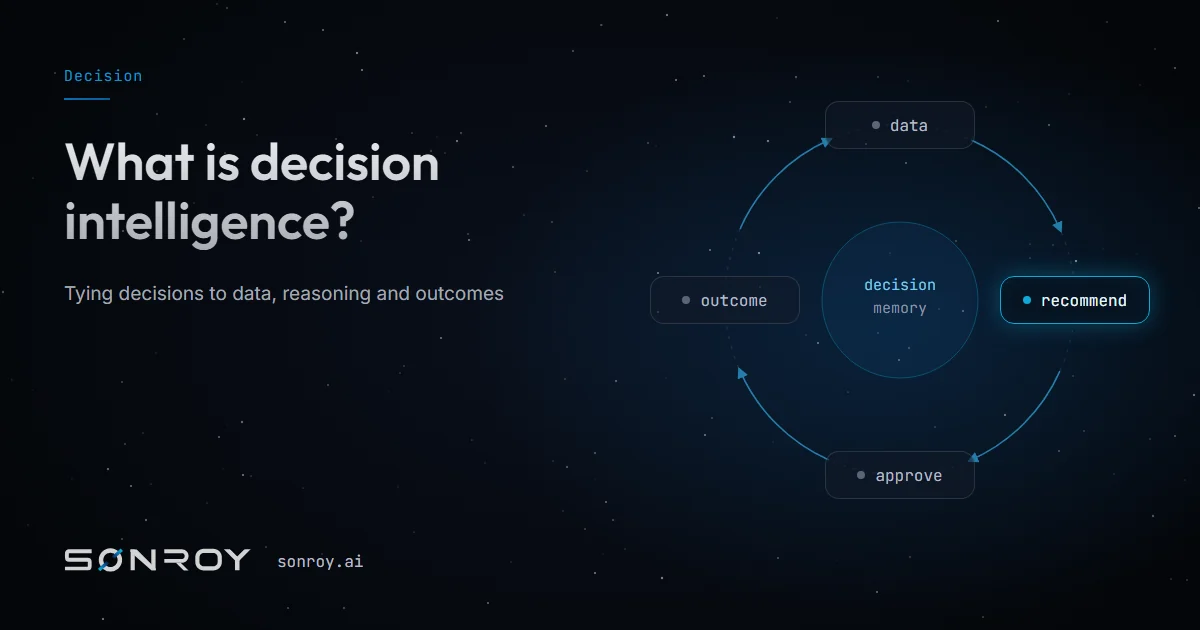
Decision intelligence is the discipline of explicitly designing how an organisation makes decisions, tying each decision to data and reasoning, and learning from its outcome to improve the next one. The question is not “what happened?” but “what should we do now, why, and what came of it?”
A short definition
Gartner defines decision intelligence as a practical discipline used to improve decision making by explicitly understanding and engineering how decisions are made and how outcomes are evaluated, managed and improved through feedback. Gartner listed it among its strategic technology trends for 2022 and published its first Magic Quadrant for Decision Intelligence Platforms on 26 January 2026. One of the people who popularised the idea in business is Cassie Kozyrkov, Google's first Chief Decision Scientist.
Three words in that definition carry the idea: engineering (a decision is built as a process, not left to what someone remembers that morning), reasoning (a recommendation arrives with why it was made) and feedback (the outcome is measured and written into the next decision).
Business intelligence, decision support, decision intelligence
The three are often confused. The difference is how close the data gets to the decision.
| Business intelligence (BI) | Decision support system (DSS) | Decision intelligence | |
|---|---|---|---|
| Question it answers | What happened? | Which option is better? | What do we do, why, and what came of it? |
| Output | Reports, dashboards | Scenarios, model results | A reasoned recommendation + approval + measured outcome |
| Who builds the decision | The person reading the report | The expert using the model | The system recommends, a person approves |
| Learning | None; the report is regenerated | When the model is updated | Every outcome is written back |
We go deeper in BI versus decision intelligence and what a decision support system is.
How does decision intelligence work?
In practice it is a four-step loop. In SONROY the loop is called senses, thinks, helps you decide, learns:
- Senses: ERP, e-commerce, call-centre, logistics and marketplace data come together in one model; stale information is flagged.
- Thinks: A product, process or decision is scored 0–100. The company sets the criteria; the system does the maths.
- Helps you decide: Not a report but a recommendation: action, priority and reasoning. A person approves or rejects; on approval the relevant system is triggered.
- Learns: The outcome is written back and the score updated. A rejected recommendation teaches too: over time it shows when the person was right and when the recommendation was.
The loop needs a memory underneath it. Sources connect to a shared core rather than to each product separately, so a rule learned in one area holds in the next. In SONROY that core is SNR Core.
What is decision intelligence used for? Retail and fashion examples
Retail is where decision intelligence is most visible: decisions are frequent, repeated and measurable. The same questions are asked every day and answered again every season.
- Catalog: Which product leads the category page? Ranking with sales, stock and newness data (S0 Ecom).
- Demand: What will sell next season, how much, through which channel, with what size curve (S0 Forecast).
- Production and sourcing: Which product, which size, which supplier, how many; the size × colour return matrix becomes a production correction (S0 Supply).
- Customer: Reviews, complaints and return reasons attach to the product and its attributes (S0 Customer).
- Marketing: Which product, which channel, how much budget; spend is tied to sales (S0 Marketing).
- Stores, logistics, finance: Stock allocation, carrier and delivery decisions and budget variance are read from the same memory (S0 Store, S0 Logistics, S0 Finance).
One decision through the loop: an example
A fashion brand's e-commerce team re-ranks the first page of the women's outerwear category every Monday. With decision intelligence the decision turns like this: the system reads sell-through, stock cover and new arrivals; scores each product; prepares a recommendation such as “move the 42 new arrivals into the first three pages and pull back products whose stock is below four weeks of cover”, with its reasoning. The category manager approves and the ranking goes live. A week later the ranking's effect on sales is measured and the score updated. The following Monday the recommendation arrives knowing that result.
What decision intelligence is not
It is not another dashboard: a dashboard is a screen people look at, while decision intelligence measures the return of the decision made. It is not automation that decides instead of people: the recommendation comes with its reasoning and the owner stays human. And it does not replace existing systems: ERP, the e-commerce platform and marketplace integrations stay where they are; the decision layer runs on top of them.
How to choose a decision intelligence platform
- Does it run on top of your existing systems? It should connect to ERP, the e-commerce platform and marketplace integrations, not replace them.
- Is the output a recommendation? A tool that produces dashboards is business intelligence, not decision intelligence.
- Does it show its reasoning? If the recommendation does not say which data it rests on, approving or rejecting it is blind.
- Does it write the outcome back? A system that does not learn gives the same recommendation every season.
- Does it have a shared memory? If a rule learned in one decision area is not used in the next, every new area starts from zero.
- Who keeps the data? Company data and the learned memory should stay with the company.
How to start with decision intelligence
- With one repeated, measurable decision. In retail this is usually catalog ranking or the reorder decision. A weekly decision turns the learning loop fastest.
- By writing down the decision as it is today. Who decides, which data they look at, how long it takes, how the outcome is measured.
- By connecting sources to a shared memory. The data the decision needs must sit in one model, or the recommendation stays fragmented too.
- By setting up the approval flow. Recommendation, reasoning, approval, trigger, outcome. Rejected recommendations are recorded as well.
- By moving to a second area on the same core. The second decision area uses the same data, so the set-up cost does not repeat.
To see SONROY on your own data, read about the thirty-minute demo, or first measure where your company stands with the decision memory test.
Short answers
No. AI is a technology; decision intelligence is a discipline. It uses AI, but its focus is the decision itself: which data to look at, how the recommendation is reasoned, who approves it, and how the outcome is measured and written back.
No. The system prepares a recommendation with action, priority and reasoning; a person approves or rejects it. On approval the relevant system is triggered and the outcome is measured. A rejected recommendation is recorded and teaches too.
No. What you need is for the sources the decision depends on (ERP, e-commerce, marketplaces, call centre, logistics) to connect to a shared memory. Existing systems stay in place; the decision layer runs on top.
The most repeated decision whose outcome is easiest to measure. Usually catalog ranking or the reorder decision; because they repeat weekly, the learning loop turns quickly.
Summary
- Decision intelligence engineers the decision, reasons it and learns from its outcome.
- BI shows what happened; decision intelligence recommends what to do and measures the result.
- The loop has four steps: senses, thinks, helps you decide, learns.
- Start with one repeated, measurable decision; the second area uses the same core.
Related
No decision from zero: why company memory is AI's real job
Data collection is solved; deciding is not. Why companies still decide with what one person remembers, where the cost of memoryless decisions gets booked, and how one living memory changes it.
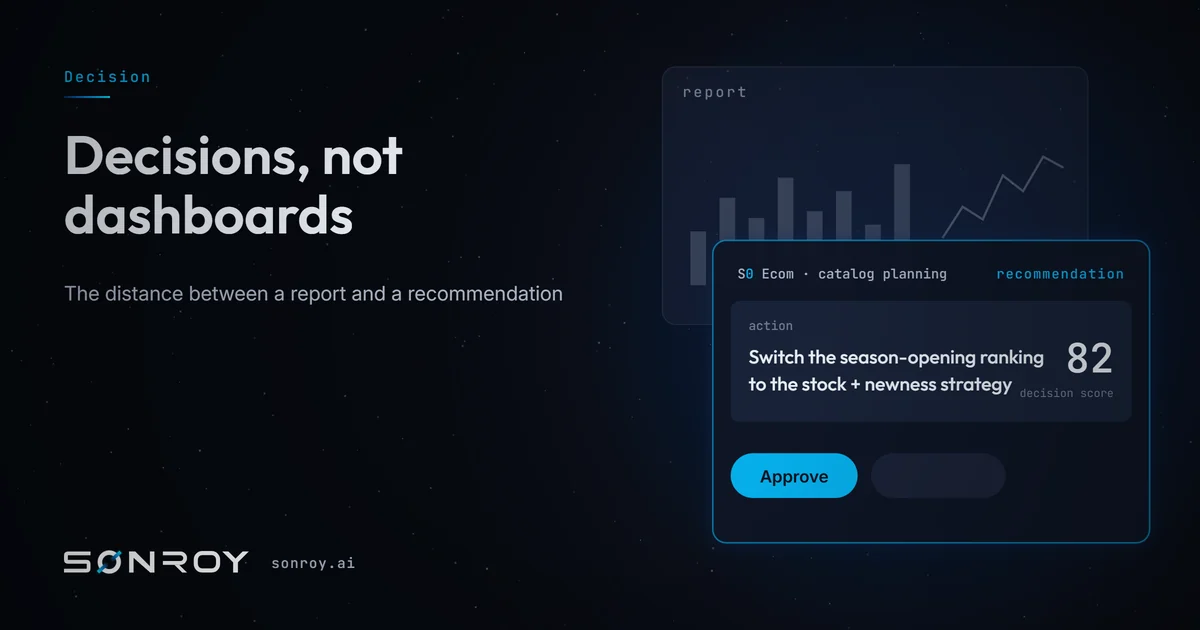
Decisions, not dashboards: the distance between a report and a recommendation
You do not measure the screen people look at; you measure the return of the decision they make. The difference between a report and a recommendation, what the approval triggers, and how it changes the management meeting.
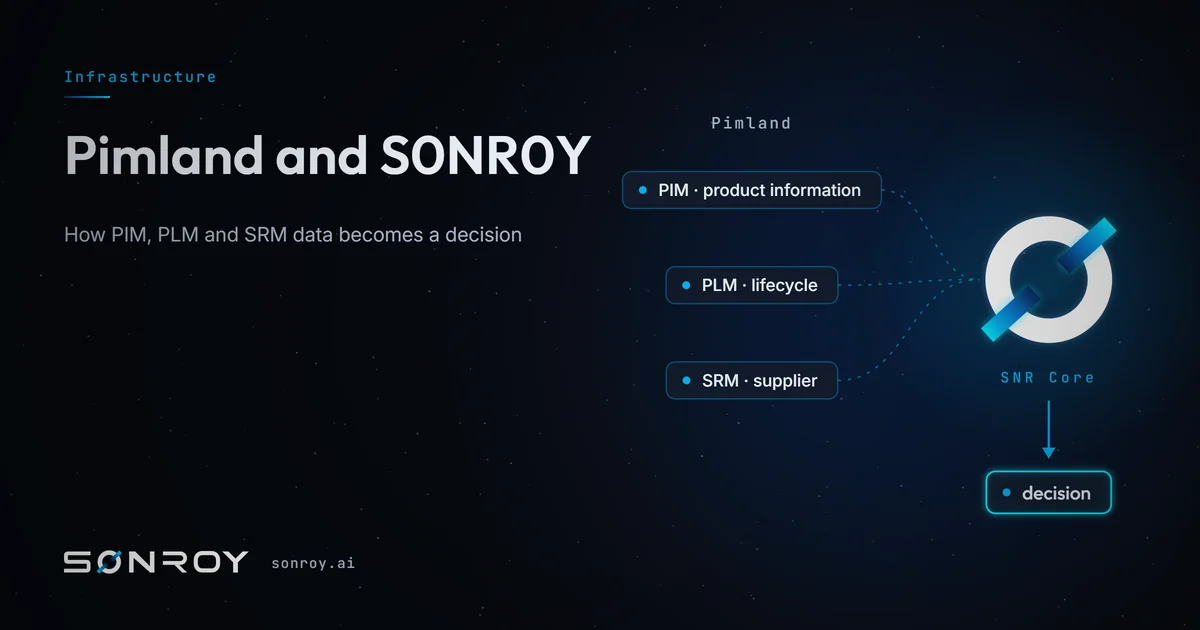
Pimland and SONROY: how PIM, PLM and SRM data becomes a decision
Pimland gives birth to the product: information, lifecycle, supplier. SONROY reads the same data and turns it into decisions. Where the full integration of the two platforms opens up efficiency in retail operations, module by module.