
What is a decision support system? How AI changed it
A decision support system (DSS) lets a manager compare options for a decision. How it evolved since 1971, its types, and three things AI changed.
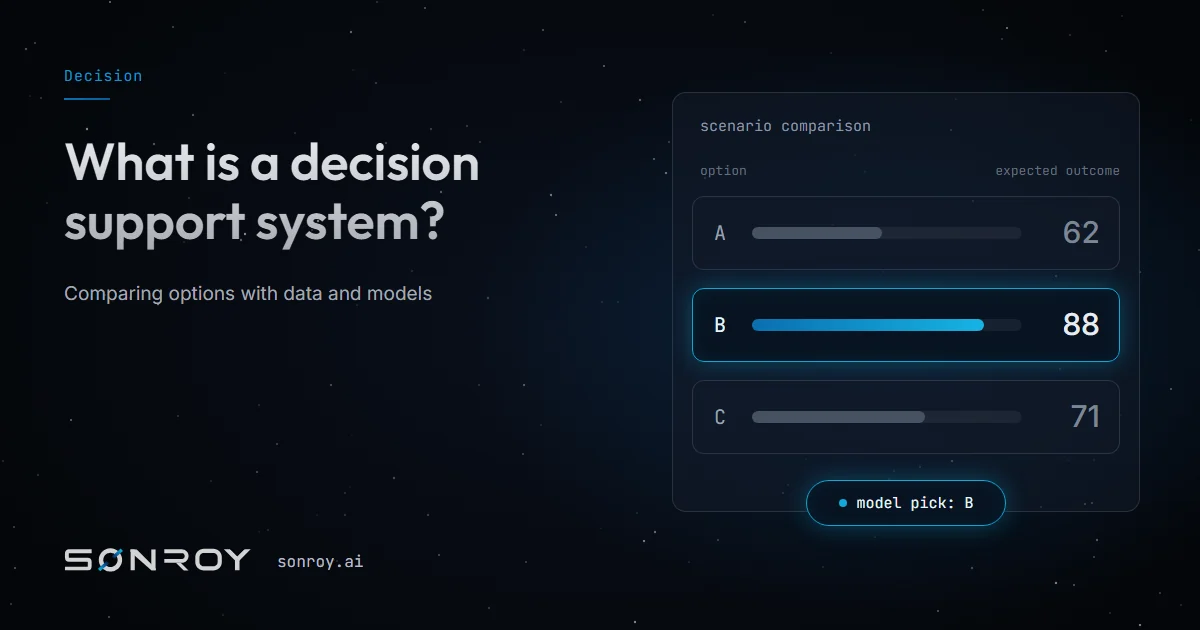
A decision support system (DSS) is an information system that lets a manager compare the options for a decision using data and models. It does not make the decision; it shows the person who will make it which option is better and why.
Where the term comes from
The term took hold with “A Framework for Management Information Systems”, published in 1971 by G. Anthony Gorry and Michael S. Scott Morton. The paper classified management decisions on two axes: how structured the decision is (from routine to uncertain) and at which management level it is taken (operational, managerial, strategic). Classic management information systems were proposed for structured decisions, and decision support systems for semi-structured ones.
Types of decision support systems
- Data-driven: Queries and summarises historical data. The ancestor of today's BI tools.
- Model-driven: Answers “what if” with optimisation, simulation or forecasting models.
- Knowledge-driven: Produces recommendations from expert rules (once called expert systems).
- Document- and communication-driven: Organises documents or team discussion around a decision.
Today these usually merge in one product; the real distinction is whether the system produces a report or a recommendation. The report-producing side is what we now call business intelligence.
Three things AI changed
1. Data no longer comes from one source. A classic DSS queried a data warehouse. A retail decision today needs ERP, e-commerce, marketplace, call-centre and logistics data at once. AI makes it possible to bring those sources into one model and flag stale information.
2. The output is a reasoned recommendation, not a list of options. The model does not just rank options; it states which action, with which priority, and why. Instead of interpreting a table, the manager approves or rejects a recommendation.
3. The system learns from the outcome. In a classic DSS the model stayed the same until someone updated it. Today the outcome of every approved or rejected recommendation is written back, and the next recommendation knows it. That loop is called decision intelligence.
Decision support system examples: retail
A fashion brand decides mid-season which product to reorder. In the classic approach the planning team opens the sales report, the stock report and the returns report separately and joins them by hand. In an AI-supported decision system the recommendation reads: “Reorder this product in M and L, cancel S; sell-through has been high for two weeks and the S return rate is above the category average.” The planner approves, the order proposal goes to the sourcing system, and the outcome is measured at season end. In SONROY this decision runs in S0 Supply and S0 Forecast. The same pattern applies to category ranking, campaign budgets and store stock allocation.
Five questions when choosing a decision support system
- Does it connect to your existing ERP and e-commerce stack, or replace it?
- Is the output a report, or a recommendation with its reasoning?
- When a recommendation is approved, is the relevant system triggered?
- Is the outcome written back so it shapes the next recommendation?
- Does a rule learned in one decision area carry over to the next?
The last two questions separate a classic decision support system from decision intelligence. In SONROY sources connect to a shared core, SNR Core, rather than to each product, so the second decision area uses the same data and the same learning.
Short answers
An ERP records transactions: orders, stock, invoices. A decision support system uses those records to compare options for a decision. The ERP holds what happened; the DSS supports what to do.
Partly. Data-driven decision support systems are the ancestors of today's BI tools. BI stops at the report; a DSS stops at comparing options for a specific decision.
In three ways: it brought several sources into one model, turned the output from a list of options into a reasoned recommendation, and let the system learn from outcomes. That last step is the move to decision intelligence.
Summary
- A decision support system compares options; a person makes the decision.
- The term took hold with Gorry and Scott Morton's 1971 paper.
- With AI, data merged, the output became a reasoned recommendation and the system began learning from outcomes.
- The question to ask: is the outcome written back and carried into the next decision area?
Related
No decision from zero: why company memory is AI's real job
Data collection is solved; deciding is not. Why companies still decide with what one person remembers, where the cost of memoryless decisions gets booked, and how one living memory changes it.
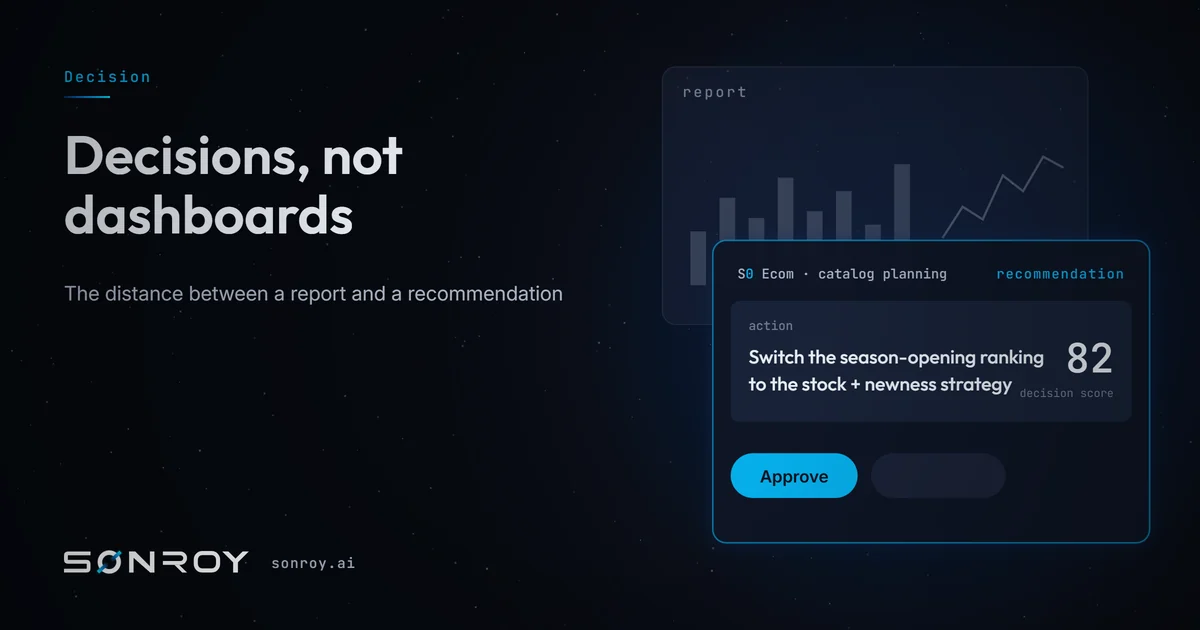
Decisions, not dashboards: the distance between a report and a recommendation
You do not measure the screen people look at; you measure the return of the decision they make. The difference between a report and a recommendation, what the approval triggers, and how it changes the management meeting.
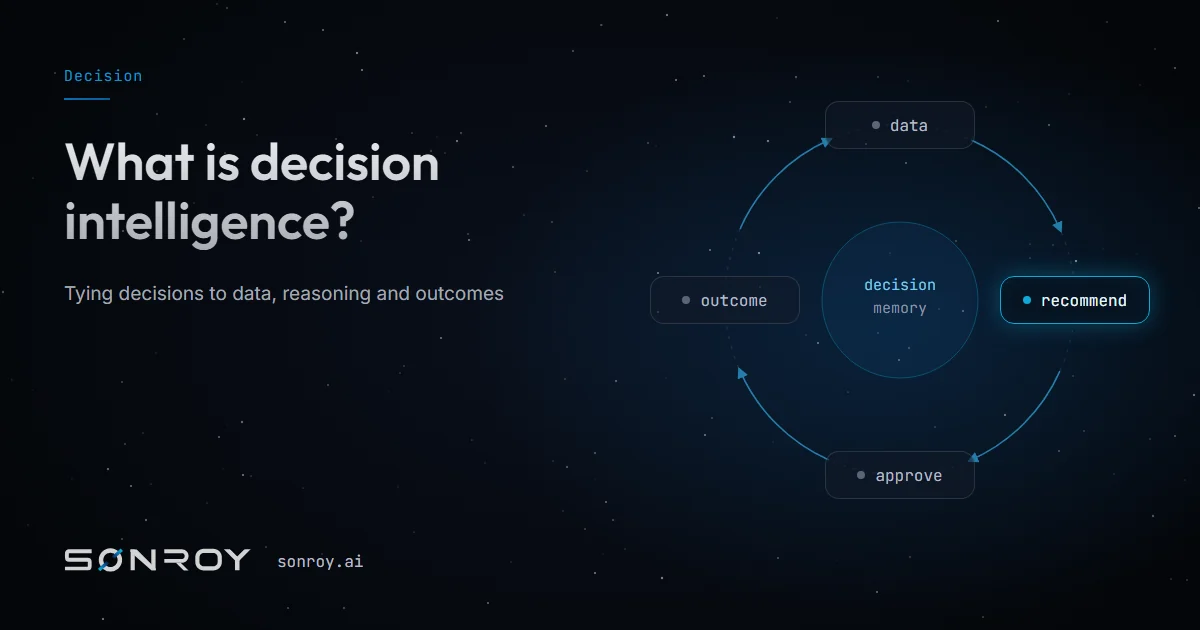
What is decision intelligence? A guide from data to decision
Decision intelligence is the discipline of engineering how decisions are made and learning from their outcomes. How it differs from BI, how it works in retail and where to start.