
How do CEOs get value from AI? Six findings from the 2026 surveys
In the October 2026 EY-Parthenon CEO survey, AI is the biggest source of productivity gains. Yet in PwC's survey more than half of CEOs see no financial return yet. Six findings from the two surveys and what they mean for leaders.
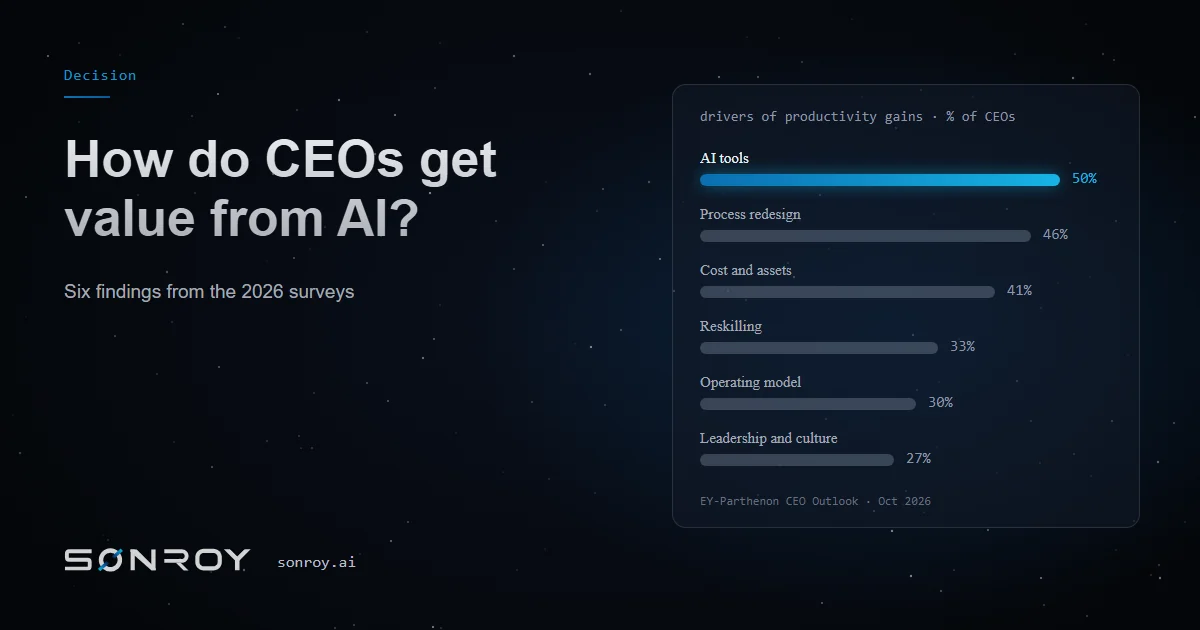
The common message of the 2026 CEO surveys is clear: AI delivers productivity, but that productivity does not turn into profit on its own. In the EY-Parthenon CEO Outlook published in October 2026, half of CEOs (50%) name AI tools as the largest contributor to productivity gains over the past 12 months. In PwC's Global CEO Survey published the same year, 56% of CEOs say they have not yet seen a significant financial benefit from AI. The difference lies in whether productivity is tied to decisions and measurement.
What does the EY-Parthenon CEO Outlook (October 2026) say?
The EY-Parthenon CEO Outlook is an anonymous online survey of 1,200 CEOs of large companies in 21 countries, run in August and September 2026. The question: which factors contributed most to productivity gains in your organisation over the past 12 months? The answers describe several levers working together, not a single one.
| Factor | Global | Americas | Asia-Pacific | Europe |
|---|---|---|---|---|
| Adoption of AI-enabled tools and applications | 50% | 52% | 47% | 50% |
| Business process redesign and simplification, including automation | 46% | 49% | 41% | 45% |
| Cost and asset optimisation | 41% | 41% | 43% | 38% |
| Workforce reskilling | 33% | 31% | 37% | 33% |
| Operating model transformation | 30% | 29% | 29% | 31% |
| Supply chain and sourcing optimisation | 29% | 31% | 29% | 27% |
| A value realisation office to manage, track and capture gains | 29% | 27% | 31% | 29% |
| Leadership and organisational culture change | 27% | 25% | 27% | 29% |
| We have not seen any material productivity gains | 1% | 1% | 0% | 0% |
Sources: EY (Ernst & Young), EY-Parthenon CEO Outlook, October 2026 · PwC (PricewaterhouseCoopers), 29th Global CEO Survey, 2026. Regional breakdown from EY-Parthenon's survey presentation.
Finding 1: AI is the biggest contributor, but not on its own
AI tools rank first at 50%. Process redesign follows closely at 46%. The headline of EY's presentation sums it up: AI delivers the most value when paired with other levers of transformation. A tool added on top of an old process speeds up that process as it is; unless the process is redesigned, the value stays limited.
Finding 2: Almost everyone sees productivity gains
Only 1% of CEOs globally say they have seen no material productivity gains. So the question is no longer “does AI work?”. The question is where the freed time and capacity go.
Finding 3: Productivity is not turning into profit
According to EY's press release, 23% of CEOs say productivity gains are absorbed by complexity, regulation, risk and new work demands. PwC's 29th Global CEO Survey (4,454 CEOs in 95 countries, September–November 2025) shows the same picture from another angle: 56% of CEOs have not yet seen a significant financial benefit from AI, and only 12% report both cost and revenue benefits.
Finding 4: Few CEOs see the return in real time
In the EY survey, 16% of CEOs say they have comprehensive, real-time visibility of AI costs and returns. A return that is not measured cannot be managed: if nobody knows what each decision delivered, the investment stays a “pilot” forever.
Finding 5: A structure that measures value makes a difference
A “value realisation office” that manages and tracks productivity gains is among the productivity factors for 29% of CEOs. PwC draws a similar line: companies with strong foundations, such as a Responsible AI framework and a technology environment that enables enterprise-wide integration, are three times more likely to report meaningful financial returns.
Finding 6: Talent will be a bigger barrier than capital
In the EY survey, 72% of CEOs expect skills shortages to be a bigger barrier to growth than access to capital within three years. Yet only 15% say productivity gains are reinvested in workforce development. In the words of Andrea Guerzoni, EY-Parthenon Global Vice Chair: “productivity alone is not a strategy”.
What do these findings mean for leaders?
The gap the surveys reveal is not a technology gap; it is a decision gap. AI frees up time, but in most companies it is not defined which decision that time turns into, whether the decision's outcome is measured, or whether the outcome is written back into the next decision. Decision intelligence builds exactly this loop: it ties the recommendation to data and reasoning, triggers the approval, measures the outcome and writes it back.
EY's recommendations to CEOs point the same way: measure outcomes, not adoption; redesign workflows before resizing; decide in advance where gains are reinvested; and govern AI by decision risk. We covered the difference between reporting and deciding in business intelligence vs decision intelligence and decisions, not dashboards.
Five questions for the board
- In which decisions do we use AI, and do we have a list of those decisions?
- Is each decision's outcome measured, or only usage?
- Where do the freed time and capacity go: into growth, or into new work?
- Did we redesign the process before adding AI?
- Who owns the value delivered by AI, and are its cost and return visible in one place?
Where do you start?
With one decision that repeats every week and whose outcome can be measured. SNR Core brings company data into one memory; S0 modules use that memory to recommend the decision with its reasoning and measure the outcome. To see this loop on your own data, book a demo. For companies that want to take AI investment to management level, we also offer AI strategy and process consulting.
Short answers
Yes. In the October 2026 EY-Parthenon CEO Outlook, 50% of CEOs name AI tools as the largest contributor to productivity gains over the past 12 months; only 1% say they have seen no material gains.
Gains are often absorbed by complexity, regulation and new work (EY: 23%), and returns are not measured (EY: 16% have real-time visibility). In PwC's survey, 56% of CEOs have not yet seen a significant financial benefit.
They redesign processes, measure outcomes rather than adoption, and build strong foundations. According to PwC, companies with strong AI foundations are three times more likely to report meaningful financial returns.
The gap they reveal is a decision gap: which decision the freed capacity turns into, and whether its outcome is measured, is undefined. Decision intelligence joins the recommendation, the approval and the measured outcome in one loop.
Summary
- EY-Parthenon CEO Outlook (October 2026): AI is the largest source of productivity gains at 50%, followed by process redesign at 46%.
- PwC's 29th Global CEO Survey: 56% of CEOs see no significant financial benefit yet; 12% see both cost and revenue benefits.
- Only 16% of CEOs see AI returns in real time; an unmeasured return cannot be managed.
- The gap is in decisions, not technology: productivity turns into profit when it is tied to a decision and its outcome is measured.
Related
No decision from zero: why company memory is AI's real job
Data collection is solved; deciding is not. Why companies still decide with what one person remembers, where the cost of memoryless decisions gets booked, and how one living memory changes it.
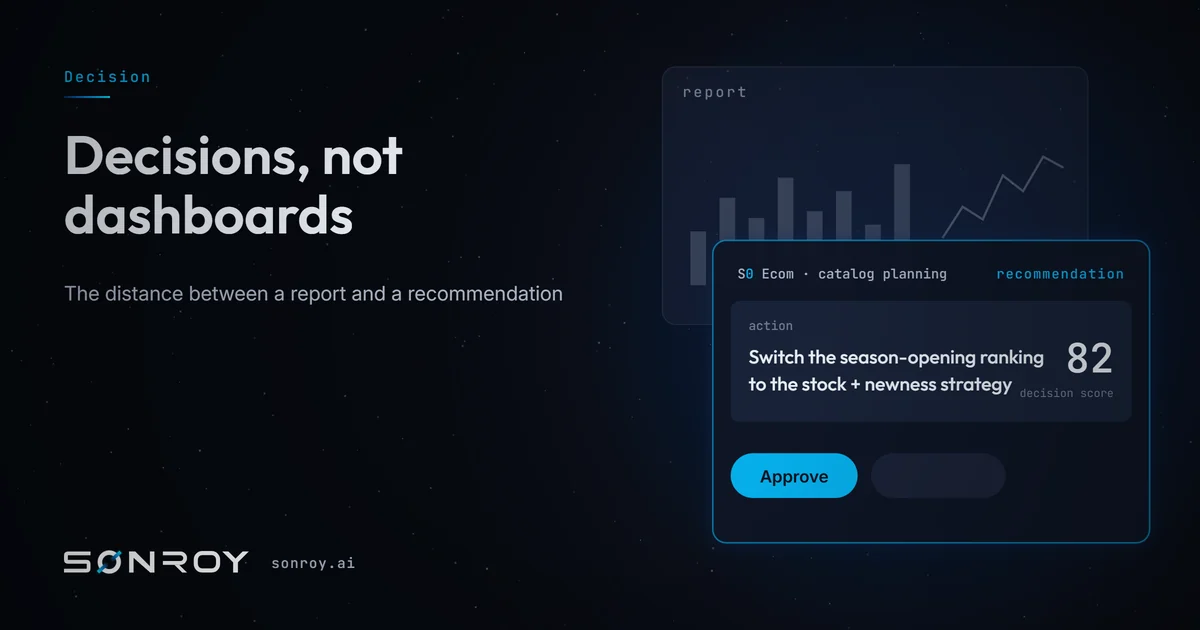
Decisions, not dashboards: the distance between a report and a recommendation
You do not measure the screen people look at; you measure the return of the decision they make. The difference between a report and a recommendation, what the approval triggers, and how it changes the management meeting.
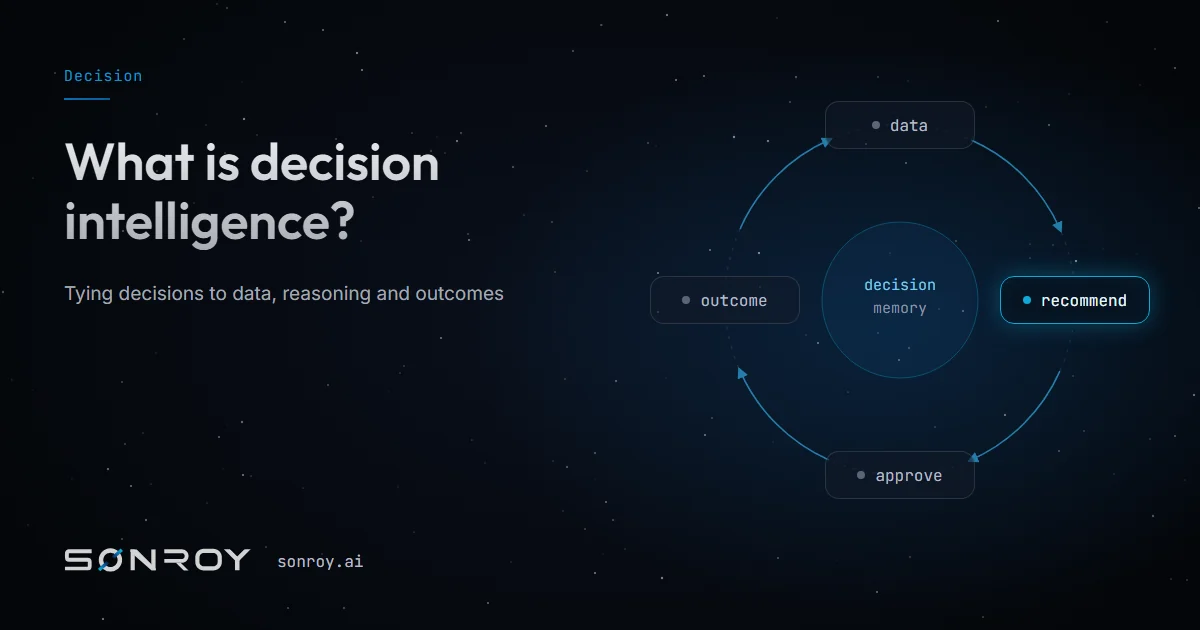
What is decision intelligence? A guide from data to decision
Decision intelligence is the discipline of engineering how decisions are made and learning from their outcomes. How it differs from BI, how it works in retail and where to start.