
How to use AI in e-commerce: 9 decision areas
AI in e-commerce is not one tool but a set of decisions: product content, catalog ranking, competitor prices, customer questions, returns, demand and budget. What changes in each and where to start.
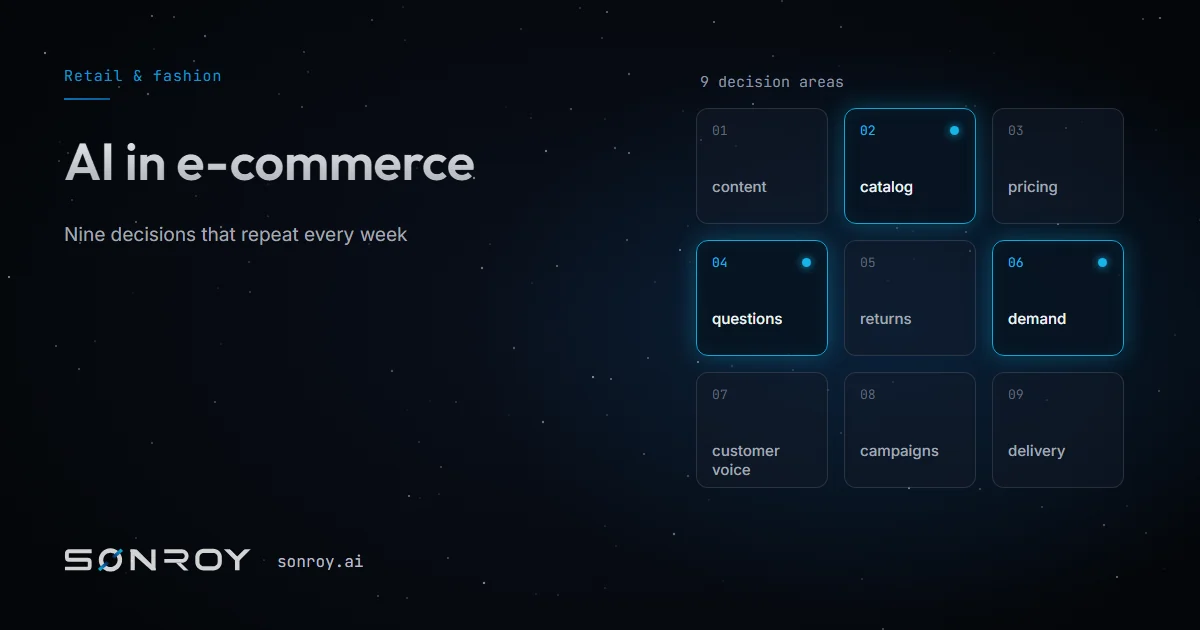
AI in e-commerce is used to make the decisions that repeat every week, such as product content, catalog ranking, competitor pricing, customer questions, returns, demand and campaign budgets, with data, with reasoning and with the outcome measured. It is usually thought of as a single tool: a chatbot, a product description generator, a recommendation engine. But e-commerce is a set of repeated decisions, and the real value of AI is making those decisions with the same data, with reasoning, and with measurement. Below are nine decision areas and what changes in each.
AI in e-commerce: 9 decision areas
1. Product content and data quality
Missing attributes, weak descriptions and wrong visuals push a product down in both search and category pages. AI enriches each product with its own attributes, visuals and brand voice and scores data quality from 0 to 100; low-scoring products get fixed first. (S0 Ecom · Product Enrichment)
2. Catalog and category ranking
Deciding which product leads a category page takes category teams days. When sell-through, stock cover, newness and markdown status are read together, the ranking is built from ready strategies or a free-form command. More in category ranking. (S0 Ecom · Catalog Planning)
3. Competitor and price tracking
In-season products of chosen competitors are tracked by category; the brand's position in the price band reads green, amber or red. The decision is not “change the price” but “why are we expensive on this product and what should we do?” (S0 Ecom · Market Intelligence)
4. Customer questions and marketplaces: the AI assistant
Product, shipping and stock questions are the most repeated customer contact. An AI assistant answers them live with product and order data; in group companies each brand speaks in its own voice. We explain how in the agent rule matrix. (S0 Ecom · Helpdesk Agent)
5. Size and returns
In fashion most returns come from size and fit. Personal size advice cuts returns at the start; the size × colour return matrix takes the fit problem back to production. See how return data becomes a production decision. (S0 Ecom · Size Advisor, S0 Supply)
6. Demand and stock
What will sell next season, how much, through which channel; what the size curve should be; when to mark down. The forecast does not stay a report; it is tied to order and catalog decisions. (S0 Forecast)
7. Voice of the customer
When marketplace reviews, call-centre logs and return reasons attach to the product and its attributes, the complaint “this fabric is thin” reaches the product team and production. (S0 Customer)
8. Campaigns and budget
Online, offline and agency spend is measured in one return account: which product, which channel, how much budget. Campaigns are built in line with stock; a product about to sell out is not pushed. (S0 Marketing)
9. Delivery and “where is my order”
Order, carrier and warehouse data do not sit apart from customer questions; the assistant answers “where is my order” instantly, and head office reads delay and cost by channel. (S0 Logistics)
A separate AI tool per area, or a shared memory?
You can buy a separate AI tool for each of these nine areas. The problem is that the tools do not know what the others learned: return data does not reach size advice, customer complaints do not reach production, stock does not reach campaigns. In no decision from zero we called this tool inflation. In SONROY every area reads the same memory, SNR Core; what is learned in one holds in the next.
Where to start with AI in e-commerce
Most e-commerce teams start with the most visible and most repeated decision: catalog ranking or product content. Once the first area settles, the second is built on the same data. To see which area comes first for you, take the decision memory test, or look at your own data in the thirty-minute demo. The full concept: what is decision intelligence.
Short answers
In frequent decisions whose outcome is measured: product content and data quality, catalog ranking, customer questions, size and returns, demand and stock. Because these decisions are made again every week, AI's learning loop turns quickly.
Each tool can do its own job, but it does not know what the others learned. Return data does not reach size advice; customer complaints do not reach production. When areas read the same memory, what is learned in one is used in the next.
Product, shipping and stock questions can be answered with product and order data. How the answer reaches the marketplace depends on the integration each marketplace offers sellers.
Summary
- AI in e-commerce is not one tool but nine repeated decisions.
- Fastest return: product content, catalog ranking and customer questions.
- When size and return data reach production and the customer's voice reaches the product, learning flows across areas.
- Start with the most visible decision; the second area is built on the same data.
Related
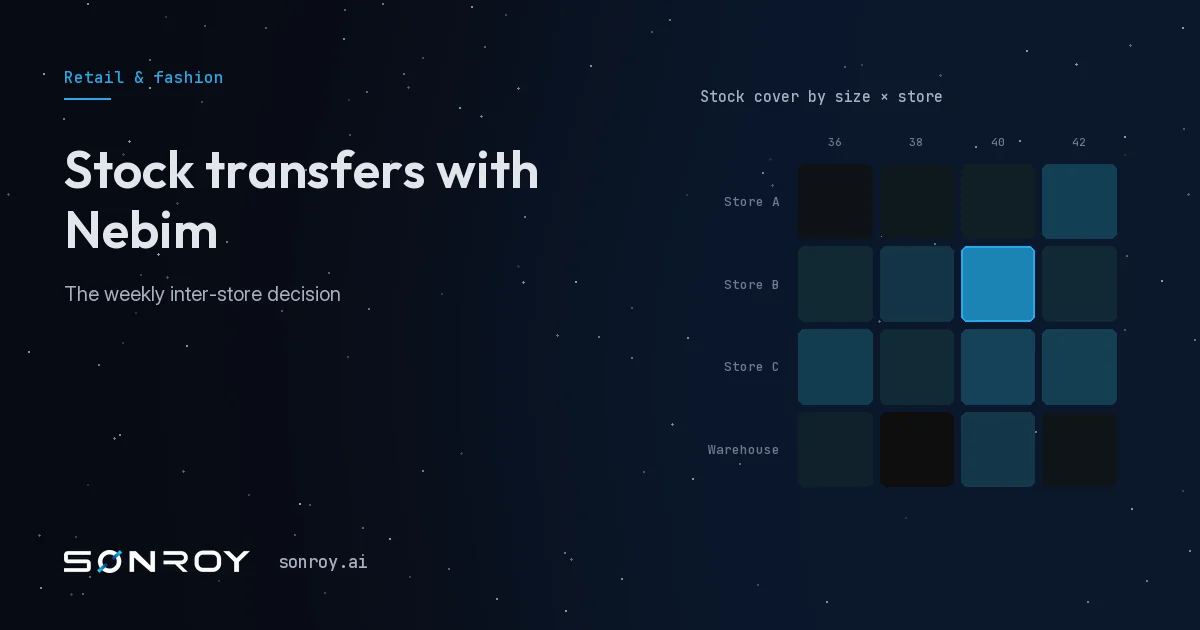
Inter-store transfer decisions from Nebim stock data
An inter-store stock transfer pairs a store with broken sizes with a store where the same stock is waiting. Turning Nebim's stock record into a weekly, reasoned transfer recommendation; cost, frequency and an example decision flow.
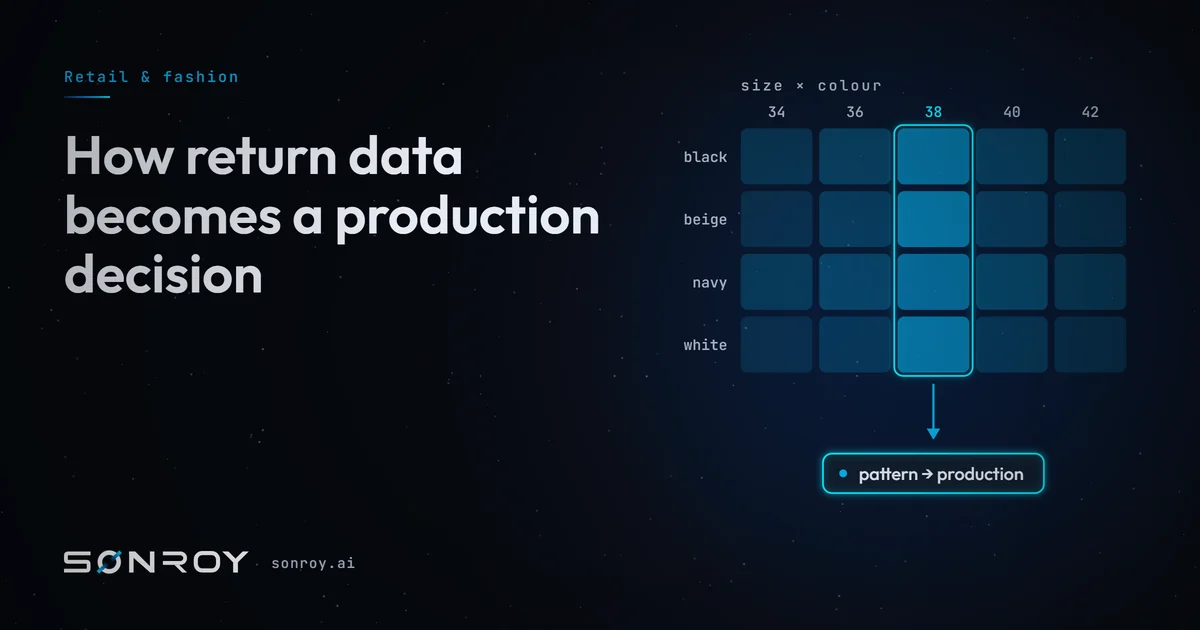
How return data becomes a production decision
The size × colour return matrix is not a report; it is a production instruction. The level at which returns should be read in fashion retail, three different causes, three different owners, and the path from that level to action.
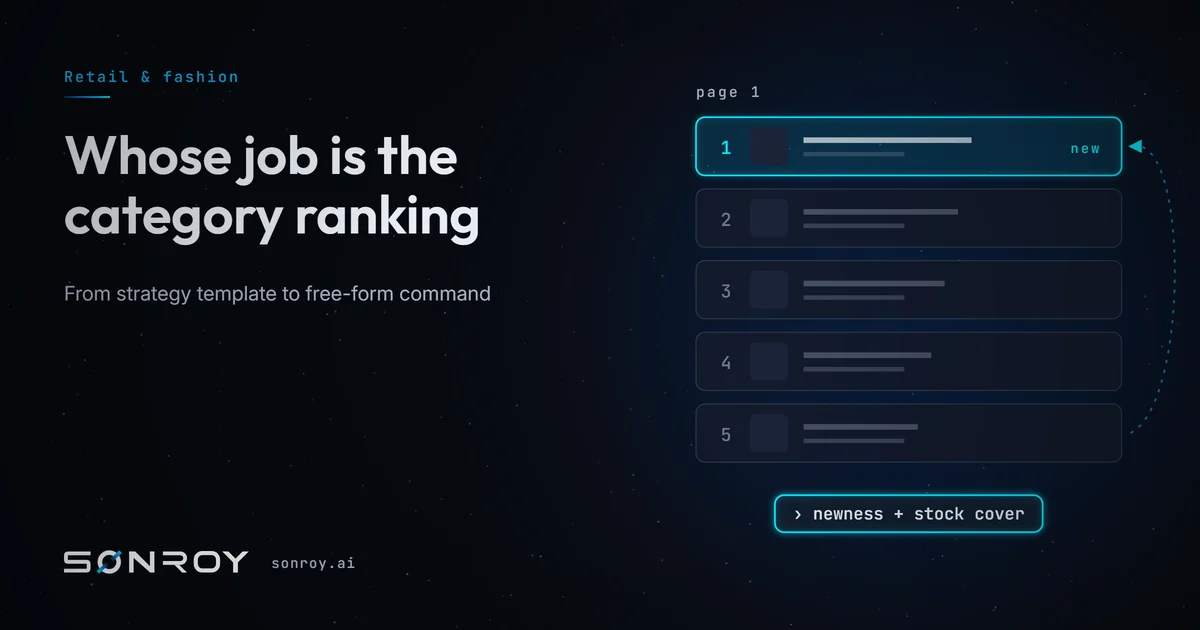
Whose job is the category ranking: from strategy template to free-form command
Deciding which product sits on the first page of an e-commerce category used to take a person days. How strategy templates and free-form commands reduced that work to one command, and where the category specialist's job moved.