
Business intelligence vs decision intelligence
Business intelligence shows what happened; decision intelligence recommends what to do and measures the result. The difference in six points, how they work together, and where the shift starts.
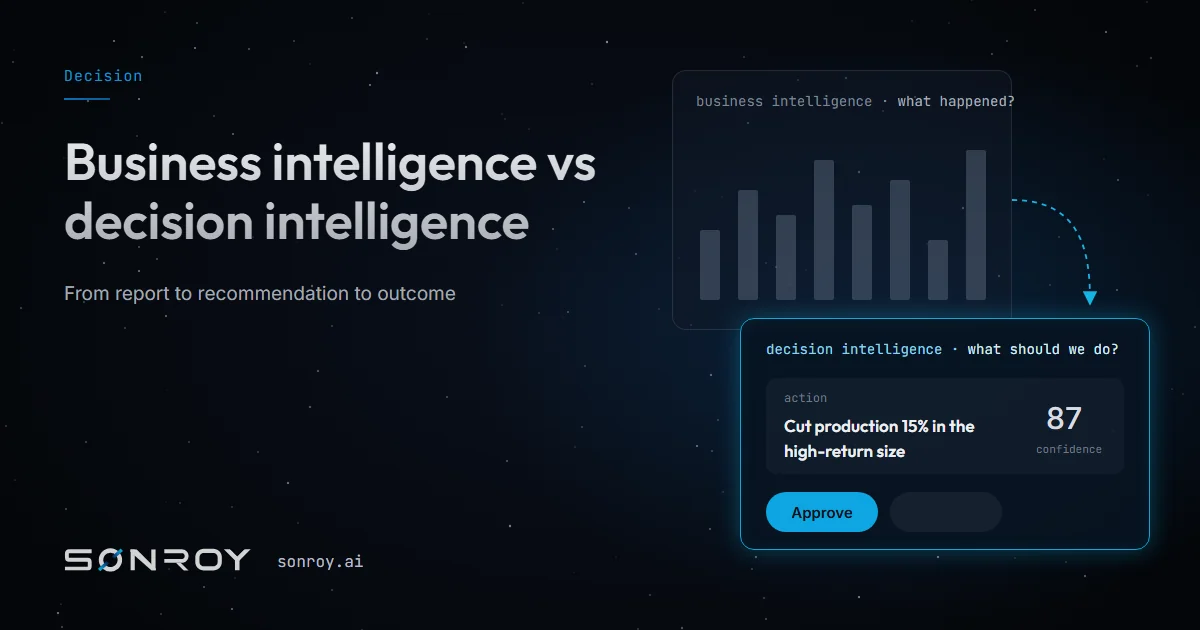
Business intelligence (BI) shows what is happening in a company; decision intelligence recommends what should be done, with its reasoning, and measures the outcome. One ends with a report, the other with a decision. Neither replaces the other; decision intelligence starts where business intelligence stops.
Business intelligence vs decision intelligence in six points
| Business intelligence | Decision intelligence | |
|---|---|---|
| Question | What happened, and why? | What do we do now, and why? |
| Output | Reports, dashboards, KPIs | Action, priority and reasoning |
| User | The analyst or manager reading the report | The manager approving the decision |
| Timing | Looks back, at period end | At the moment of decision, continuously |
| Link to action | Action is taken outside the report | Approval triggers the relevant system |
| Learning | The report is regenerated | The outcome is written back; the recommendation improves |
Why a dashboard is not enough
Every chart on a dashboard can be right and still no decision comes out. The decision sits where several dashboards intersect: sell-through on one, stock on another, returns on a third, the competitor's price on none. A person builds that intersection, and the decision depends on how much time they have that day. We described this gap in decisions, not dashboards: you do not measure the screen people look at, you measure the return of the decision they make.
The same decision, two approaches: an example
With business intelligence: On Monday morning the category manager opens three reports: last week's sales, current stock and return rates. Within an hour they decide which products to push forward and send the list to the e-commerce team. What the decision rested on stays in the manager's head; a week later nobody knows whether the result came from that decision.
With decision intelligence: The same data already sits in one model. The system scores each product and prepares the recommendation with its reasoning: “Move these 18 products to the first page; sell-through is above the category average and stock cover is six weeks.” The manager approves or swaps a few products; the ranking goes live. A week later the outcome is measured and which change worked is recorded.
When is business intelligence enough?
Not every report needs to become a decision area. For strategic decisions made once a year, one-off analyses and audit reports, business intelligence is enough. Decision intelligence makes the difference where the same kind of decision repeats often and its outcome can be measured: weekly ranking, reordering, campaign budgets, size curves.
How do business intelligence and decision intelligence work together?
Business intelligence does not disappear; it becomes one of decision intelligence's inputs. Reports, KPIs and historical data enter the decision model's memory. The difference is that this knowledge reaches the person not as a table but as the reasoning behind a recommendation. When S0 Ecom recommends a category ranking, the reasoning cites sell-through, stock cover and newness; the manager does not open three reports.
Where does the shift to decision intelligence start?
- Pick one report and ask: which decision does the person reading it end up making? The answer is a decision area.
- Write that decision in one sentence: “Every Monday we re-rank the first page of the category.”
- Bring the decision's data into one model: the sources behind the report connect to a shared memory (SNR Core).
- Set up recommendation and approval: the system recommends, a person approves, the outcome is measured.
- Do not retire the report yet: it stays as a control until the decision area settles; usually it gets opened less on its own.
For the full concept see what is decision intelligence; to measure where you stand today, take the decision memory test.
Short answers
No. BI becomes one of its inputs: reports and KPIs enter the decision model's memory. The difference is that the knowledge reaches the person as the reasoning behind a recommendation, not as a table.
Reports whose reader makes the same kind of decision every week: category sales (ranking), stock (reorder), returns (size and production), campaigns (budget allocation).
Starting with one decision area, set-up depends on connecting the sources. With SONROY the scope and timeline are set in a written plan after the demo.
Summary
- BI shows what happened; decision intelligence recommends what to do.
- The decision sits where several reports intersect; today a person builds that intersection.
- BI does not disappear; it becomes an input to decision intelligence.
- The shift starts with one report and the single decision behind it.
Related

No decision from zero: why company memory is AI's real job
Data collection is solved; deciding is not. Why companies still decide with what one person remembers, where the cost of memoryless decisions gets booked, and how one living memory changes it.
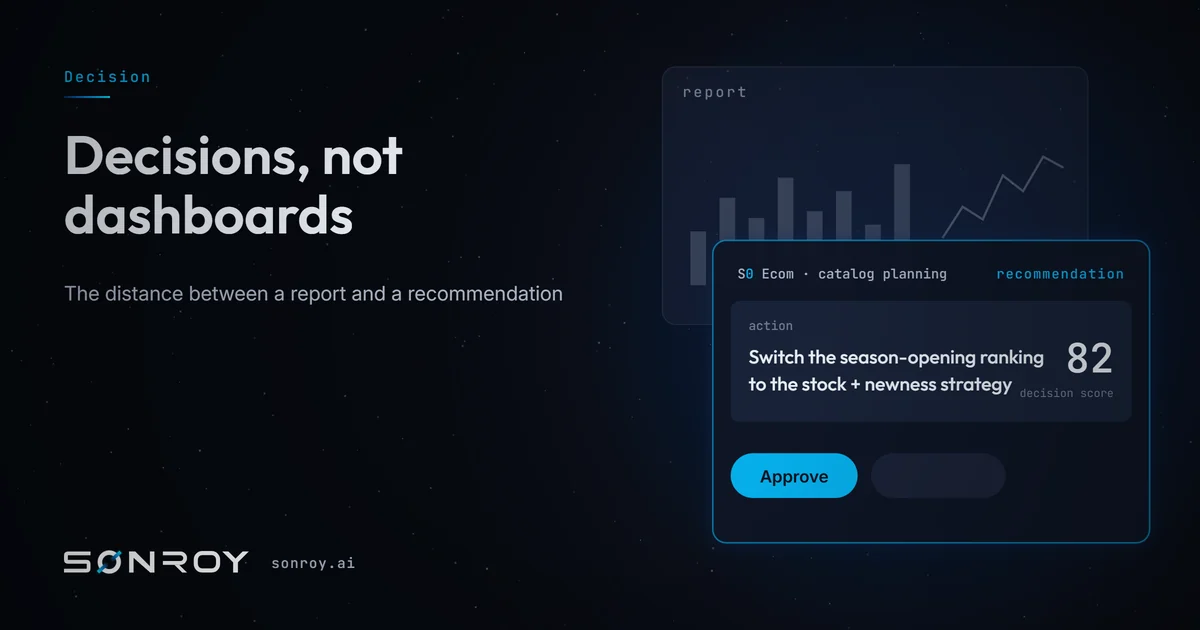
Decisions, not dashboards: the distance between a report and a recommendation
You do not measure the screen people look at; you measure the return of the decision they make. The difference between a report and a recommendation, what the approval triggers, and how it changes the management meeting.
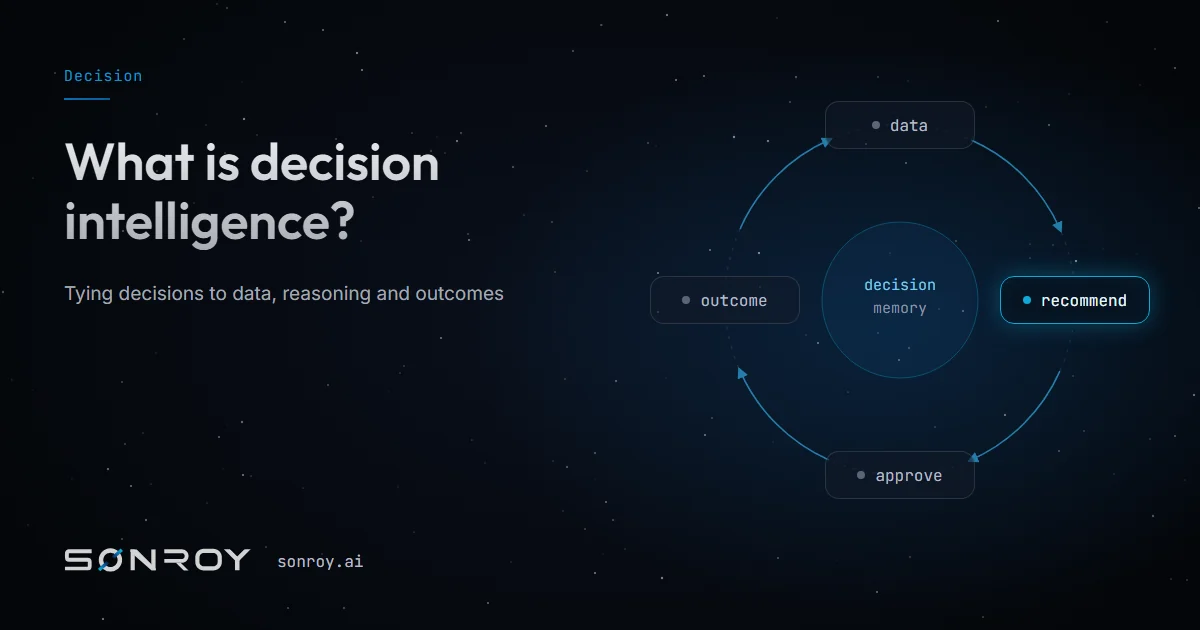
What is decision intelligence? A guide from data to decision
Decision intelligence is the discipline of engineering how decisions are made and learning from their outcomes. How it differs from BI, how it works in retail and where to start.