
Collection depth from Nebim sales data: how many units to order?
Collection depth is the decision of how many units of each style to order, in which colour and size split. How to turn past sales held in Nebim into that decision, an example decision flow and where to start.
Collection depth is the decision of how many units of each style to order for the new season, and in which colour and size split. For a retailer running Nebim, the raw material for this decision is already in place: past seasons' sales, stock and returns are recorded in full in Nebim. Decision intelligence turns that record into an order recommendation with its reasoning written down.
This is the first post in our series “Decision intelligence for retailers on Nebim”. Each week we take one Monday decision that grows out of the record Nebim keeps.
In short
- Nebim tells you accurately what sold last season, in which store and in which size.
- “How many units of this style?” is answered when demand forecasts, size curves and return signals are added to that sales history.
- In SONROY this decision is built in S0 Forecast: the recommendation arrives with its reasoning, a person approves it, the outcome is measured in season and written into next season's recommendation.
- Nebim stays where it is; the decision layer runs on top of it.
A familiar moment in the buying meeting
The season buying meeting. On the table is last season's Nebim report: sales by style, sell-through by store, the size breakdown. The report is complete and correct.
Still, the real question of the meeting starts where the report ends: “How many units of this new style should we buy?” Last season's best seller is not in the range this season. In its place is a similar fit, a different fabric and a new colour. Nobody can say “it sold this much last season”, because the style is new.
In the end the decision is usually made by the most experienced person's instinct. Instinct is valuable; but because its reasoning is not written down, what went right or wrong is not written down at the end of the season either. The next buying meeting begins with the same question.
What does Nebim do very well here?
Nebim is an ERP widely used in apparel, footwear and accessories retail in Türkiye, covering store retail end to end. Nebim V3 ERP keeps store sales, head-office and store stock, purchasing, transfers and returns in one record. Nebim Üretim for brands that manufacture, CRM for customer relationships and RFID solutions for physical stock tracking belong to the same family.
For the collection depth decision this is an invaluable foundation. Which category sells at which price point, in which store type and in which size has accumulated in Nebim over years. Nebim's own AI solutions also focus on turning this data into insight and action.
What SONROY does is give that record the shape of a repeated decision: every season, for every style, the same question, the same criteria, written reasoning and a measured outcome.
What the Nebim report says, what SONROY recommends
| Question | What the Nebim report says | What SONROY recommends |
|---|---|---|
| What sold last season? | Actual sales by style, colour, size and store | Separates how much of that was demand and how much was the effect of stock-outs or markdowns |
| How much will a new style sell? | The new style has no history yet | A forecast learned from similar styles, with its reasoning |
| What should the size split be? | Past seasons' sales by size | A size curve recommendation corrected with the return signal |
| Which product lines should go deeper? | Sales and stock turn by category | A reasoned recommendation on which lines to widen and which to narrow |
| What happened in season? | Weekly sales and stock movement | Tracks the deviation from the forecast and writes it into next season's recommendation |
The left column is the record, and Nebim keeps it reliably. The right column is the decision. The decision matures when a few more signals are added to the record and all of them come together under the same product identity.
Where is the answer to “how many units” hidden?
The order quantity decision feeds on four layers. The first is the sales and stock history in Nebim: what sold, where and how fast. The second is the weeks a product was out of stock: a product cannot sell when it is not on the shelf, so sales that look low are sometimes not low demand but missing stock.
The third is returns. If size 38 of a style sells a lot and comes back a lot, the sales figure alone misleads. The fourth is the product itself: fit, fabric, colour and price point. A new style is learned from the behaviour of older styles that share these attributes.
These four layers rarely sit side by side in one table. Sales are in Nebim, return reasons are on the marketplace or in the call centre, product attributes are in the product development team's files. Decision intelligence first brings these pieces together under the same product identity. We covered forecasting methods in what is demand forecasting and the challenges specific to fashion in AI demand forecasting.
How does S0 Forecast build this decision?
S0 Forecast is SONROY's area for demand, stock and collection forecasts. It combines sales, returns, competitor and season data into one forecast and does not leave the forecast as a report: it ties it to the order, catalog and budget decision.
- Demand forecast: By product, category and channel. The deviation is tracked and the model corrects itself.
- Products with no history: The forecast for a new style is built from the behaviour of similar products.
- Size split: The size curve forecast is read together with the return signal.
- Collection plan: Which product line should widen and which should narrow; a recommendation from sales and return signals.
- Decision link: The forecast flows into the order proposal in S0 Supply; an approved proposal goes to the supplier.
All of this runs on SONROY's core, SNR Core. Nebim is one of the sources the connector layer links to. The principle is short: it connects, it does not replace. Data and memory stay with the company.
An example decision flow: a new knitwear style
A fashion brand's planning team is preparing the winter order. The range has a new knitwear style that did not exist last season. With decision intelligence the decision turns like this:
- Senses: The system reads past knitwear sales in Nebim by store and size, flags the weeks that were out of stock, and adds return reasons and the new style's fit, fabric and price point.
- Thinks: It finds the past styles most similar to the new one and builds a demand forecast from their behaviour. It separately flags the size that had high returns in similar styles.
- Helps you decide: It prepares a recommendation such as “order this style slightly shallower than its peers, deepen the middle sizes, keep the high-return size at the level of similar styles”. The reasoning sits alongside: which similar styles, what sell-through, which return signal.
- Approval: The planning manager approves, adjusts or rejects. The approved quantity becomes an order proposal.
- Learns: In season, actual sales are compared with the forecast. The deviation and its cause are recorded; next season's recommendation arrives knowing that result.
A rejected recommendation teaches too. Over time it becomes visible when the planning team's instinct was right and when the recommendation was. That changes the shape of the buying meeting: the debate is no longer about the number itself but about which part of the reasoning we agree with.
Five common mistakes in collection depth decisions
- Repeating last season as is: Last season's sales are also the result of that season's stock and markdown decisions. Copying raw sales without separating those effects copies the old mistakes too.
- Missing the stock-out weeks: A style that sold out early looks like low demand. Ordered deeper, it would have sold more.
- Fixing the size curve by category: Different fits in the same category behave differently by size; the return signal is the data that says so earliest.
- Leaving the new style in a vacuum: A decision is made for a product with no history too; learning from similar products beats guessing.
- Not writing down the outcome: If the recommendation and the actual are not compared at the end of the season, the next meeting starts from zero.
The product data side: Pimland
The quality of the collection depth decision depends on how well the new style is defined. Fit, fabric, colour and cost are born before the product reaches Nebim, at the collection and sampling stage. That side is run by SONROY's sister platform Pimland; on the product data side, Pimland is 100% integrated with Nebim across all its modules.
You can follow the collection's journey before it reaches Nebim in Pimland's post on Nebim and PLM, and how the two systems work together on the Nebim integration page. How the two platforms turn into decisions together is covered in Pimland and SONROY.
Where to start
In your next buying cycle, pick one category. Write down how the order quantity is set in that category today, who decides and how the outcome is measured. Then connect the sales and stock history in Nebim to the decision layer, set up the recommendation and approval flow, and track the deviation in season. We look at the logic of widening and narrowing a range separately in collection planning with data.
Your Nebim stays in place; your decisions get faster. There is a SONROY package for every budget: start with one decision, one module, and grow as you measure. To see this flow on your own Nebim data, book a demo; how it runs is described in the thirty-minute demo. For the whole decision loop: what is decision intelligence.
Short answers
Yes. The sales, stock and return history in Nebim is the core input of a demand forecast. The decision layer combines it with stock-out weeks, return reasons and product attributes, and ties the forecast to the order proposal.
A new style is learned from past styles with a similar fit, fabric, colour and price point. The recommendation shows in its reasoning which similar styles it rests on.
No. Nebim stays in place as the system of record. SONROY's core, SNR Core, reads Nebim data, combines it with other sources and produces the recommendation.
Yes. Starting with one category and one buying cycle is the fastest way to turn the learning loop. Other categories use the same data connection.
Summary
- Order quantity reads correctly once stock-out weeks, returns and product attributes are added to sales.
- A new style is learned from similar styles; the reasoning shows that similarity.
- In-season deviation is written into next season's recommendation.
- Start with one category, one buying cycle and a written approval flow.
Related
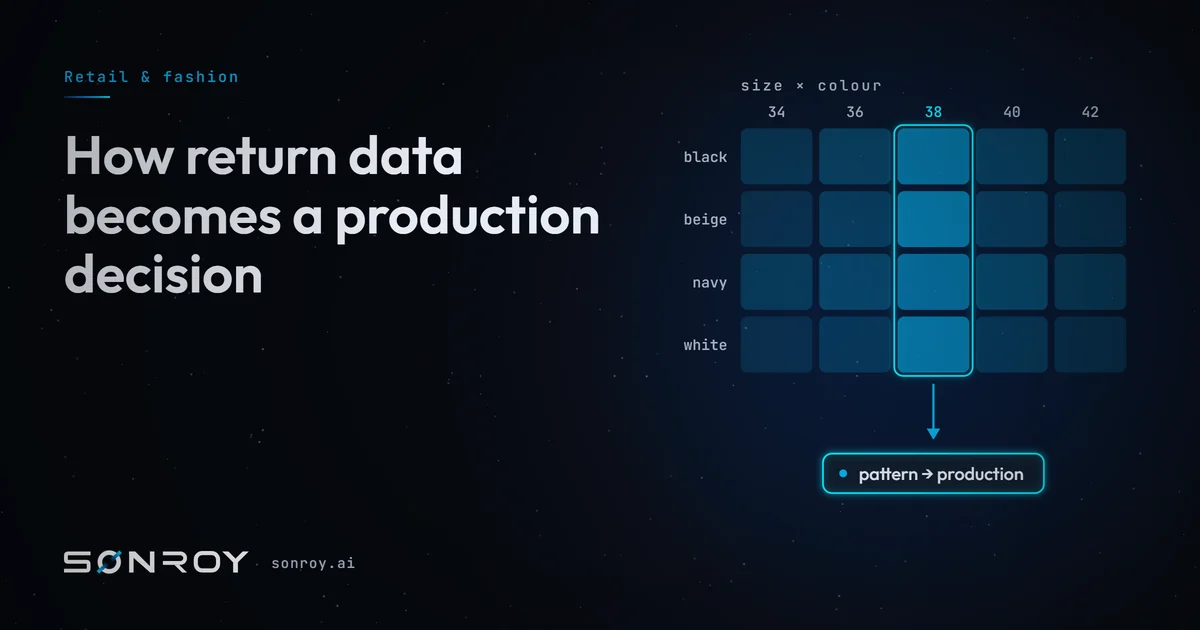
How return data becomes a production decision
The size × colour return matrix is not a report; it is a production instruction. The level at which returns should be read in fashion retail, three different causes, three different owners, and the path from that level to action.
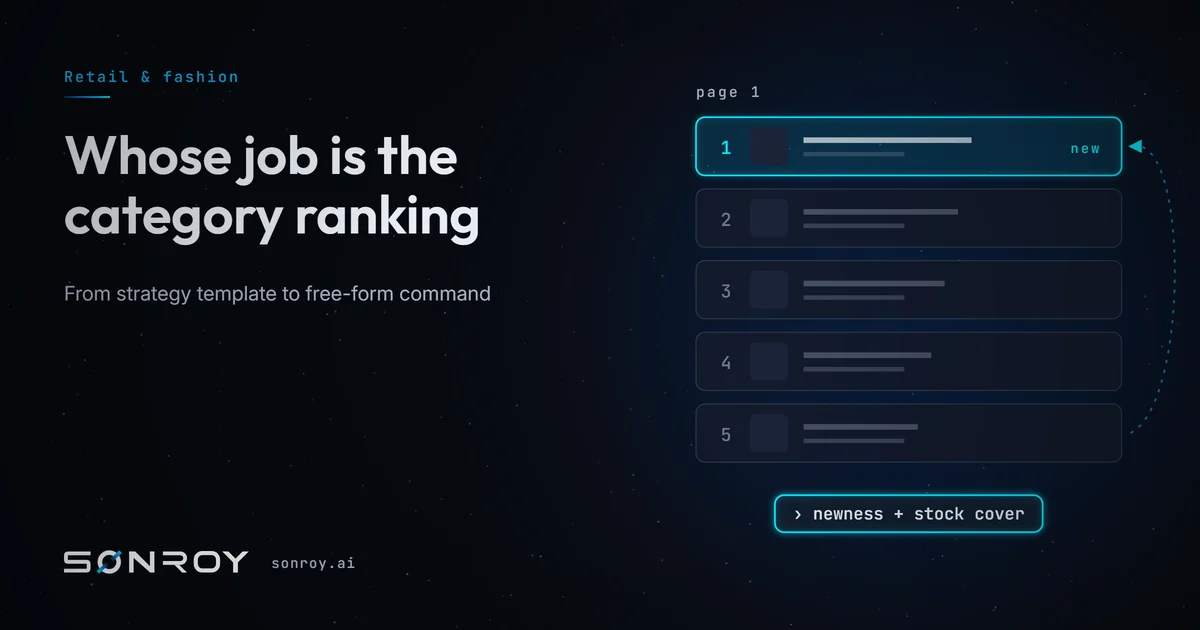
Whose job is the category ranking: from strategy template to free-form command
Deciding which product sits on the first page of an e-commerce category used to take a person days. How strategy templates and free-form commands reduced that work to one command, and where the category specialist's job moved.
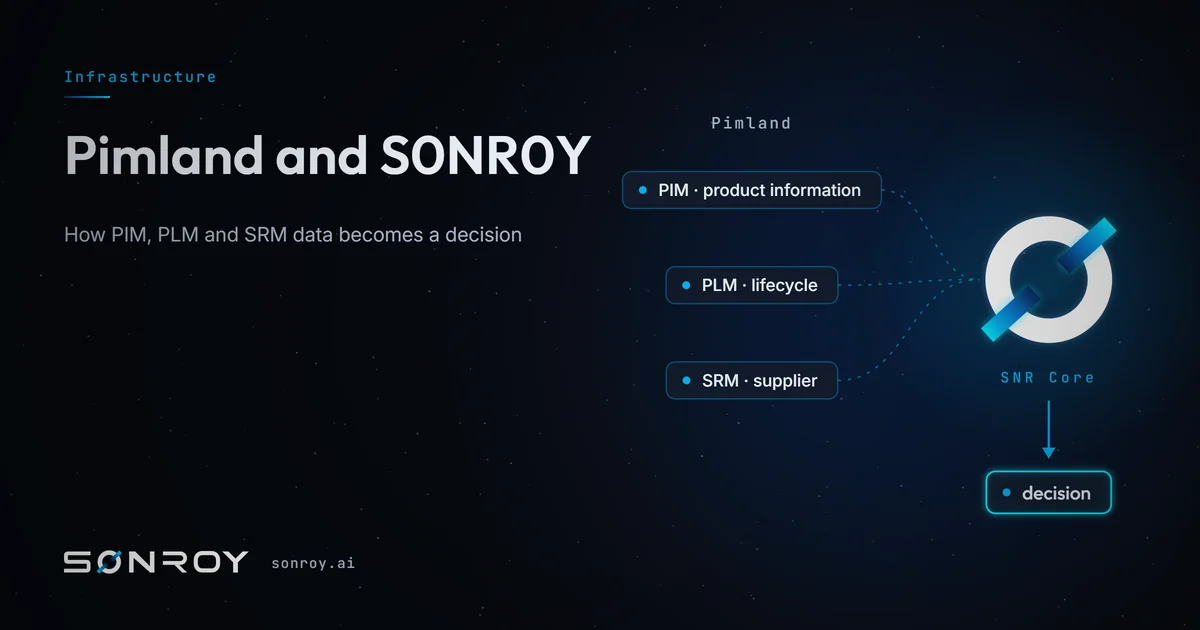
Pimland and SONROY: how PIM, PLM and SRM data becomes a decision
Pimland gives birth to the product: information, lifecycle, supplier. SONROY reads the same data and turns it into decisions. Where the full integration of the two platforms opens up efficiency in retail operations, module by module.