
Nebim and marketplaces: which products should lead a campaign?
Which products go on the first page during a campaign is a decision made by reading stock and sales in Nebim together with competitor prices and customer questions on the marketplace. A decision flow and checklist for campaign product selection.
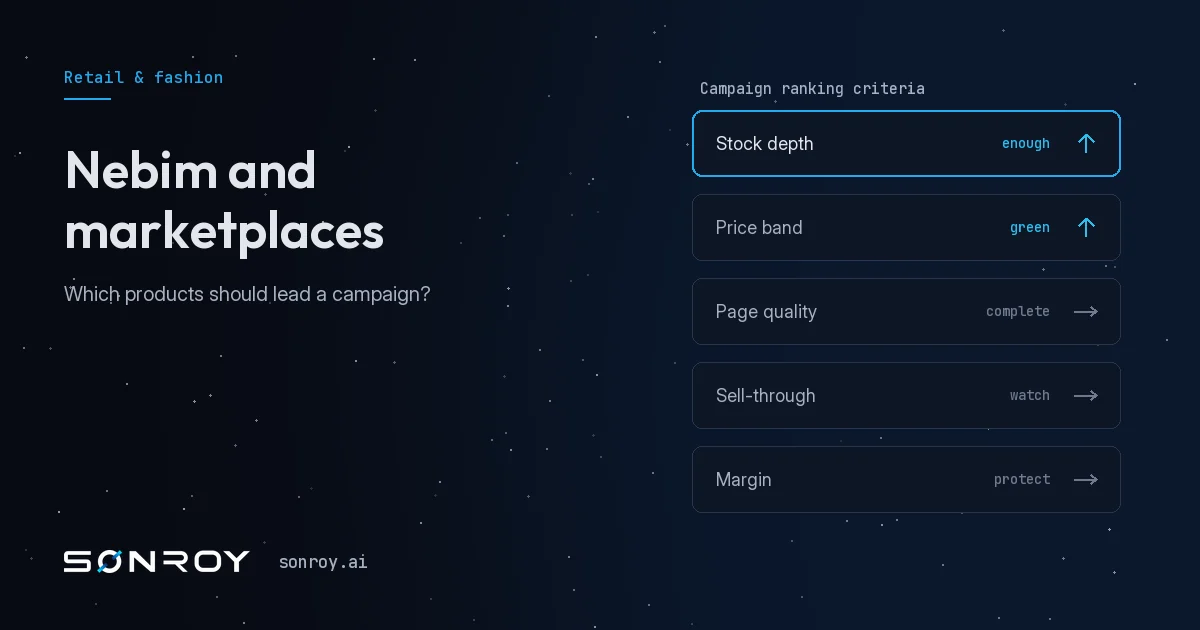
Campaign product selection is the decision of which products go on the category's first page, the marketplace showcase and the campaign list during a big sale period. For a retailer running Nebim, the stock and sales side of this decision is ready in Nebim. Decision intelligence combines that record with competitor prices on the marketplace, the quality of product data and customer questions, and turns it into a reasoned ranking recommendation.
In the third post of the series we tie Nebim's stock record to the busiest week on the e-commerce and marketplace side: campaign week.
In short
- Nebim tells you accurately how much stock you have of each product and what is selling.
- The product that should lead a campaign is chosen by reading stock depth, sell-through, position in the competitor price band and whether the product page is ready, all together.
- In SONROY this decision is built in S0 Ecom: catalog ranking, competitor price bands and live answers to marketplace customer questions feed from the same memory.
- After the campaign the ranking's effect on sales is measured and written into the next campaign's recommendation.
Nine days before the big sale
Mid-November. Nine days to the big sale week. Stock is in Nebim, products are live on the marketplace and on the brand's own site. One question sits in front of the e-commerce team: which 40 products go on the category's first page and the marketplace campaign list?
Last night a competitor changed prices in the same category. Last year's campaign best seller has shallow stock this year. A newly arrived style is missing images and its size chart is not in yet. The customer service team is bracing for the questions that will pour in from the marketplace when the campaign starts.
Every piece of this picture is recorded correctly in some system. But until the pieces come together, “which 40 products” is usually settled in a meeting, from one person's memory.
What does Nebim do very well here?
The most critical input of a campaign decision is stock: putting a product about to sell out in front means greeting customers with “out of stock” in the campaign's first hour. Nebim keeps central warehouse and store stock reliably by product, colour and size. Sales and return history sit in the same record.
Price and promotion records are managed in Nebim at many brands too. In short, the answer to “what do we have and what did we sell?” is in Nebim. The campaign decision adds the marketplace's and the customer's side on top of that answer.
What the Nebim report says, what SONROY recommends
| Question | What the Nebim report says | What SONROY recommends |
|---|---|---|
| How much stock will last the campaign? | Current stock by product, colour and size | Calculates whether the stock will last at the expected campaign-week sell-through |
| What is selling? | Sales by channel and product | Scores sales together with newness, stock cover and markdown strategy |
| Where is the competitor? | Our own price | Reads the position in the competitor's live-season price band as green, amber, red |
| Is the product page ready? | The product card and basic information | Scores data quality 0–100; flags a missing image or size chart |
| What order on the first page? | Sales records of previous campaigns | Builds the category ranking by the chosen strategy and writes its reasoning |
The left column is the campaign's solid ground. The right column is the decision about which product goes where on that ground.
How do you choose the products that lead a campaign?
A good campaign list balances five criteria. None is enough on its own.
- Stock depth: Is there enough stock to sell through the campaign, and in which sizes?
- Sell-through: How was the product selling before the campaign? Putting a slow seller in front is sometimes right to clear stock and sometimes a waste of traffic.
- Price position: Where does it sit in the price band against the competitor's products in the same segment?
- Product page quality: A product without complete images, description and size chart does not sell even on the first page; it brings returns and customer questions on top.
- Margin: Is the product still profitable after the campaign discount?
The intersection of these criteria is different for every product and changes every campaign week. Weighing the same criteria by hand every week takes a category team days. We covered the nine decision areas AI enters in e-commerce in how to use AI in e-commerce.
How does S0 Ecom build the campaign decision?
S0 Ecom is SONROY's decision engine for e-commerce. In campaign week three of its parts work together.
- Catalog Planning: 12 ready strategies, such as sales performance, stock, newness, markdown, season, outfit and slow movers, plus free-form commands. The system builds the category ranking itself. How this became a single command is in whose job is the category ranking.
- Market Intelligence: The chosen competitors' live-season products are tracked by category; the position in the price band reads green, amber, red. How the competitor price ties to the ranking decision is in competitor price monitoring.
- Helpdesk Agent: Live answers to product, shipping and stock questions on the marketplace. When question volume rises in campaign week, the answer comes from product and order data. Which question goes to the assistant and which to a person is in the marketplace customer questions guide.
All three run on SONROY's core, SNR Core, with the same Nebim connection. S0 Ecom does not replace the existing e-commerce platform; it reads it and writes the ranking, content and answers back.
An example decision flow: the campaign week first page
Back to the campaign first page of the women's outerwear category. With decision intelligence the decision turns like this:
- Senses: The system reads stock and sales by size from Nebim and adds the competitors' prices in the same segment on the marketplace, the data quality score of product pages and the results of the last campaign.
- Thinks: It scores every product by the chosen strategy. It separately flags products whose stock will not last the campaign, those in the red of the price band and those with incomplete product pages.
- Helps you decide: It prepares a recommendation such as “put products with deep stock in the green of the price band on the first page, pull the best seller whose stock will not last the campaign to page two, bring the new style with missing images forward once its content is complete”. The reasoning for each line sits alongside.
- Approval: The category manager approves or adjusts. The approved ranking goes live.
- Learns: During and after the campaign, the ranking's effect on sales and stock sell-down is measured. The result is written into the score; the next campaign's recommendation arrives knowing it.
Campaign week is when decision intelligence learns fastest: decisions are frequent and outcomes show within days.
One more detail matters: during the campaign the ranking is not a one-off. When a product's sizes start to break or a competitor changes prices again, the recommendation is updated and comes back to the category manager. The more current the stock record from Nebim, the sharper those updates.
Campaign week checklist
- Nine days before: Check stock cover for candidate products. Identify those that will not last the campaign.
- One week before: Look at the product page data quality of candidates; complete missing images, descriptions and size charts.
- Five days before: Read the competitors' price band; decide on price or ranking for products in the red.
- Three days before: Approve the first-page ranking; prepare a reserve list.
- During the campaign: Track stock sell-down daily; replace sold-out products from the reserve list and pass recurring customer-question topics to the product team.
- After the campaign: Measure the ranking's outcome and write it into the next campaign.
The product data side: Pimland
For a product on the campaign list to sell on the first page, its content has to be ready: description, images, size chart, format per channel. That content is prepared before it joins the product's record in Nebim. Why product content falls short in campaign periods and how it gets completed is covered in Pimland's post on Nebim and e-commerce product content. On the product data side, Pimland is 100% integrated with Nebim across all its modules; details are on the Nebim integration page.
Earlier in the series we looked at collection depth and inter-store transfers. The campaign decision is their e-commerce counterpart: the right stock, in the right place, in front at the right time.
Where to start
In your next campaign, start with one category. Write down who builds that category's campaign ranking today, with which data and how long it takes. Connect stock and sales in Nebim, product page data and the competitor price band to the same decision layer. Put the recommendation through an approval flow and measure the outcome when the campaign ends.
Your Nebim stays in place; your decisions get faster. There is a SONROY package for every budget: start with one decision, one module, and grow as you measure. To see the campaign ranking on your own Nebim and marketplace data, book a demo; how it runs is in the thirty-minute demo.
Short answers
Stock and sales in Nebim show which products will have enough stock through the campaign and what is selling. The decision layer combines that with the competitor price band, product page data quality and past campaign results, and recommends the category ranking.
Not always. Putting a best seller whose stock will not last the campaign on the first page means greeting customers with out-of-stock in the first hours. The recommendation weighs stock cover too.
The chosen competitors' live-season products are tracked by category. In S0 Ecom, Market Intelligence reads the position in the price band as green, amber, red and ties it to the ranking decision.
Product, shipping and stock questions can be answered with product and order data. The Helpdesk Agent in S0 Ecom answers them live on the marketplace; questions outside the brand rules are handed to a person.
Summary
- Campaign product selection is the intersection of stock, sell-through, price position, page quality and margin.
- A best seller whose stock will not last the campaign is not put on the first page; the recommendation says so with its reasoning.
- Campaign week is when decision intelligence learns fastest.
- Start with one category, one campaign and a post-campaign measurement.
Related
How return data becomes a production decision
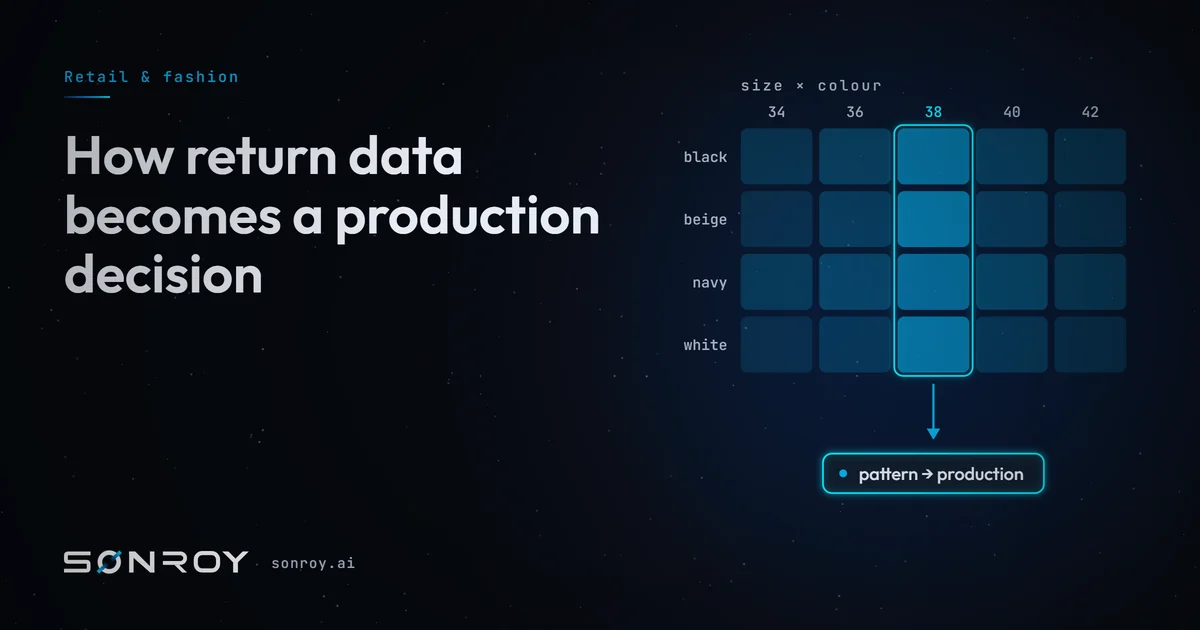
The size × colour return matrix is not a report; it is a production instruction. The level at which returns should be read in fashion retail, three different causes, three different owners, and the path from that level to action.
Whose job is the category ranking: from strategy template to free-form command
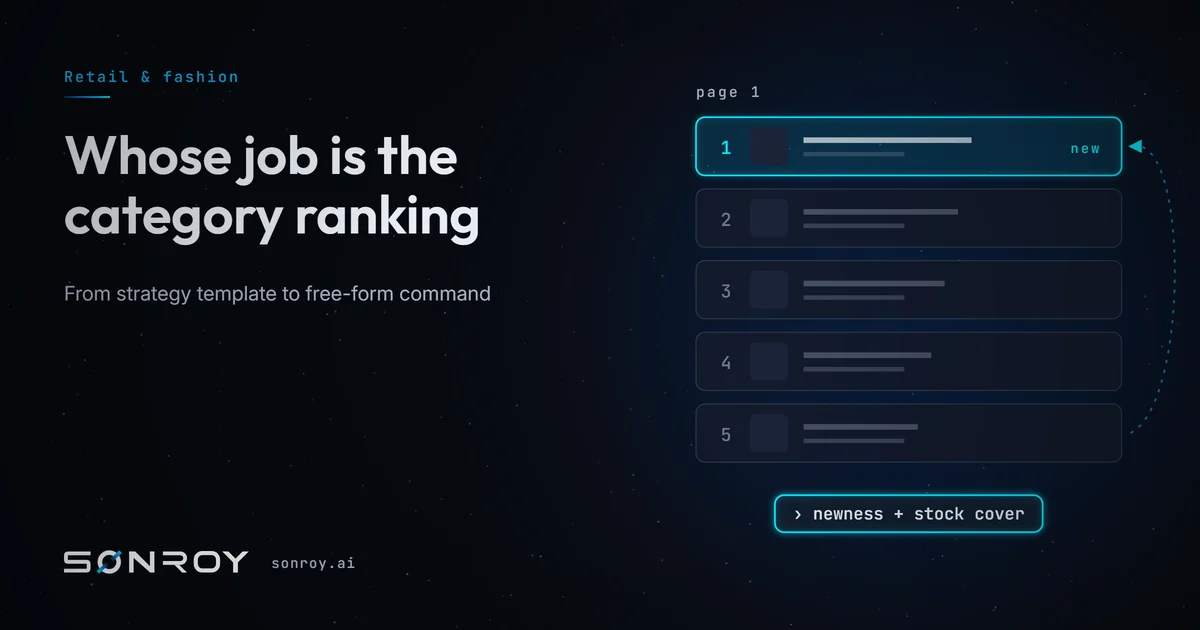
Deciding which product sits on the first page of an e-commerce category used to take a person days. How strategy templates and free-form commands reduced that work to one command, and where the category specialist's job moved.
How to use AI in e-commerce: 9 decision areas
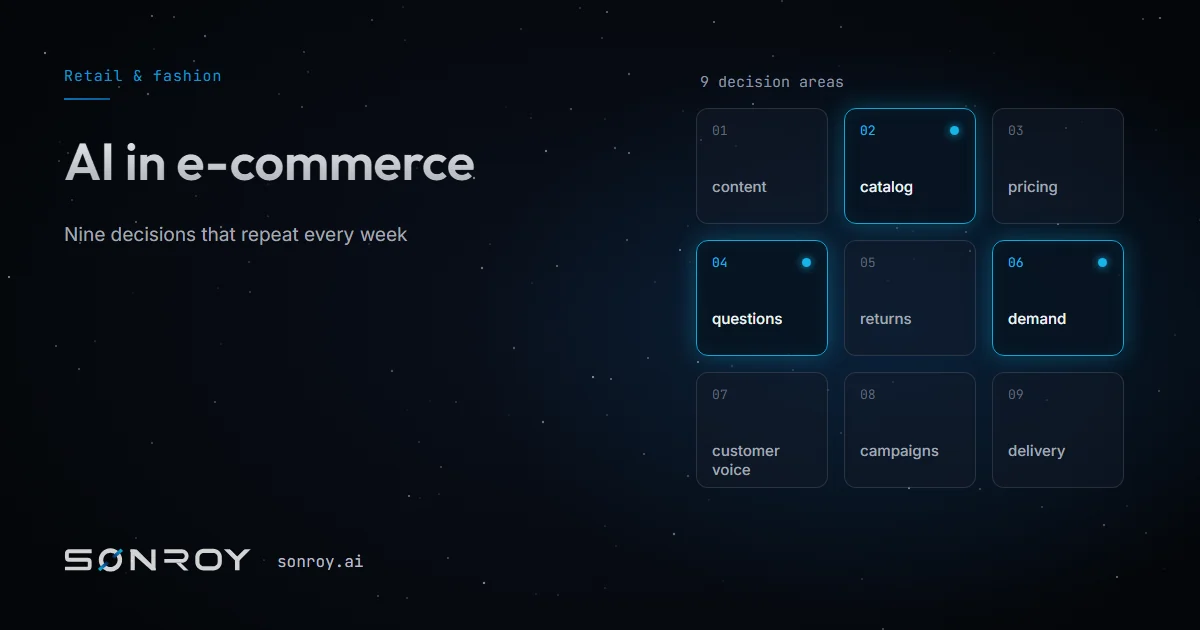
AI in e-commerce is not one tool but a set of decisions: product content, catalog ranking, competitor prices, customer questions, returns, demand and budget. What changes in each and where to start.