
Supplier performance with Nebim: who gets the next order?
When three suppliers quote the same price, who gets the order depends on last season's delivery, quality and return record. Turning the purchasing and return records in Nebim into a supplier score and a reasoned order recommendation.
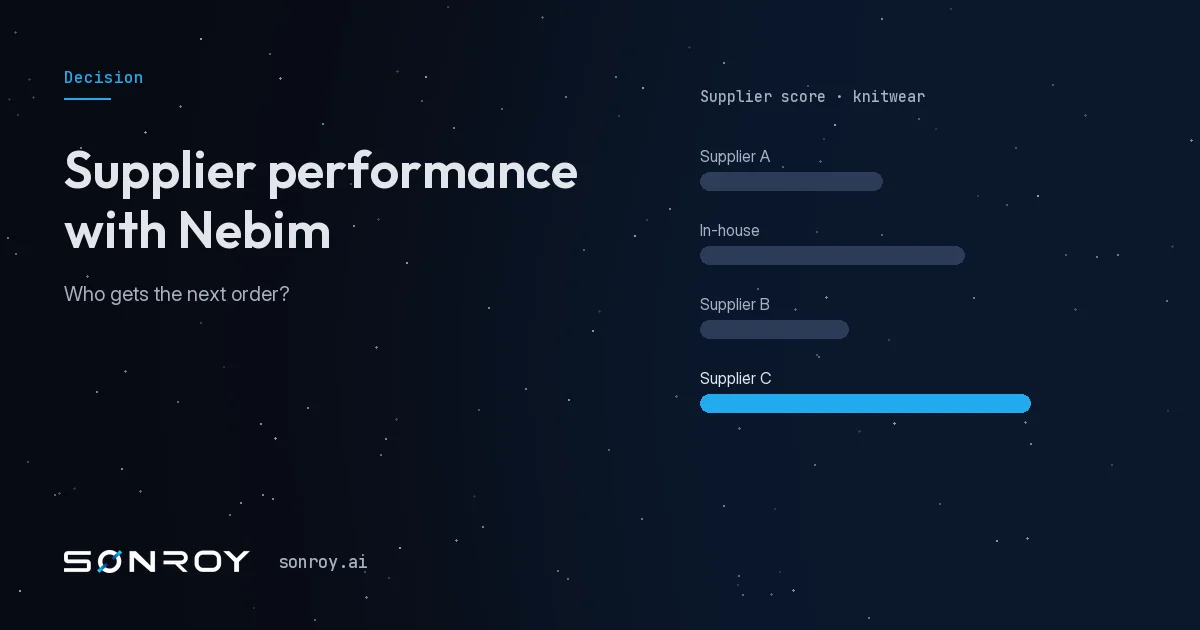
Supplier selection is the decision of which supplier or contract manufacturer gets the next order, and in what quantity. For a retailer running Nebim, the history of this decision is already recorded: when each order was placed, when the goods arrived and which products saw returns rise are all in Nebim. Decision intelligence turns that record into a supplier score and an order recommendation with written reasoning.
In the fourth post of the series we tie the purchasing and return records in Nebim to the next order decision.
In short
- Nebim keeps orders, goods receipts, stock and returns accurately; for brands on Nebim Üretim, production orders sit in the same family.
- “Who gets the next order?” is answered when those records are scored per supplier as lead time, quality, return rate and cost.
- In SONROY this decision is built in S0 Supply: the supplier score is tied to the order proposal, purchasing approves and the proposal goes to the supplier.
- Contract and in-house production are measured on the same criteria; the score updates with every delivery.
Same price, three suppliers
The purchasing meeting. Three suppliers have quoted for the new season's knitwear. The prices are very close. All of them are confident about lead times.
The question on the table: which of them was late last season, and by how much? Whose products saw returns rise? Whose goods came back from quality control? The answers actually exist. Order dates, arrival dates and the return records of products distributed to stores are sitting in Nebim.
But because these records are not brought side by side per supplier on one scale, the decision is still made from the memory of “we had a problem with that firm last season”. Memory recalls the latest problem, not the whole season.
What does Nebim do very well here?
The raw data of a supplier decision is the transaction record, and Nebim keeps it reliably. Purchase orders, goods receipts, warehouse and store stock, sales and returns are tracked in Nebim V3 under the same product code. For brands that manufacture, Nebim Üretim manages production orders and the production process within the same family.
This makes it possible to follow a product's path from order to store return through the record. What decision intelligence does is collect that path per supplier and put it in front of every order decision.
What the Nebim report says, what SONROY recommends
| Question | What the Nebim report says | What SONROY recommends |
|---|---|---|
| Did the goods arrive on time? | Order and goods receipt dates | Turns lead-time deviation per supplier into a score; warns early before the deviation grows |
| How was the quality? | Goods receipt and return records | Links the quality record to its root cause and supplier |
| Did customers bring the product back? | Returns by product | Links returns to the product's supplier and return reason and writes them into the supplier score |
| What did it cost? | Purchase price | Reads cost and margin by product together with the effect of delays and returns |
| Who gets the next order? | A list of past orders | Prepares a reasoned order proposal from score, capacity and demand forecast |
Every row in the left column is in Nebim. The right column turns those rows into a decision per supplier.
How does the supplier score connect to the order?
At many companies supplier evaluation is a once-a-year form exercise. The form is filled in, a score comes out, it goes into a file. The order decision, though, is made every week. As long as the two are not connected, the score does not change the decision.
We covered the criteria, weights and a copy-ready form in the supplier performance evaluation guide. Here we look one step further: how the score is put in front of the next order.
- The score should be continuous: Every goods receipt and every return updates the supplier's score. It does not wait for year end.
- The score should be read by product group: A supplier may be excellent in knitwear and weak in wovens. A single overall score hides that.
- The score should be read with capacity: If the highest-scoring supplier lacks the capacity to deliver on time, the recommendation should show the second option too.
- The score should meet the demand forecast: The order quantity comes from the forecast; supplier selection decides how that quantity is split and to whom.
How does S0 Supply build this decision?
S0 Supply is SONROY's decision area for sourcing, contract manufacturing and production. It scores supplier performance by lead time, quality, return rate and cost; contract and in-house production are measured on the same criteria.
- Supplier Scorecard: Delivery, quality, returns and cost on one scale.
- Order Proposal: Reorder and cancellation proposals from sell-through, stock and season data. An approved proposal goes to the supplier.
- Lead Time Monitor: Early warning of lead-time deviation.
- Quality Incidents: Quality records, root cause and supplier link.
- Capacity Planning: The balance between contract and in-house production.
The demand side comes from S0 Forecast, the return signal from S0 Ecom and S0 Customer; cost is written to S0 Finance. All of it runs on SONROY's core, SNR Core, with the same Nebim connection.
An example decision flow: the knitwear order
Back to the three suppliers above. With decision intelligence the decision turns like this:
- Senses: The system reads past seasons' purchase orders, goods receipt dates and returns by product from Nebim. It adds return reasons from marketplace and call-centre records and quality records from production.
- Thinks: It scores each supplier separately for the knitwear group: lead-time deviation, quality record, return rate and cost. The company sets the criteria and weights; the system does the maths. It separately flags a return reason that keeps recurring on one product from one supplier.
- Helps you decide: It prepares a proposal that splits the order quantity from the demand forecast across suppliers: “Give the main order to the supplier with the most consistent delivery, give a smaller batch to the second supplier, do not reorder the product with the recurring return reason until the pattern is corrected.” The reasoning sits alongside.
- Approval: The purchasing manager approves, adjusts or rejects. The approved proposal goes to the supplier; the order record is opened in Nebim as usual.
- Learns: When the goods arrive, lead time, quality and in-season returns are measured again. The supplier score updates; the next order proposal arrives knowing that result.
The most valuable part of this flow is that the decision now draws on the whole season, not on the last problem remembered. The purchasing team can put the same reasoning on the table when talking to the supplier.
Four common mistakes in supplier decisions
- Looking only at price: A low price can turn expensive once delays and returns are added. Cost should be read together with delivery and quality.
- Not linking returns to the supplier: Store returns often look like the sales team's problem. A recurring fit or fabric problem should go back to the supplier and production.
- Updating the score once a year: An annual review notices in-season deterioration only the following year.
- Measuring contract production separately: If contract and in-house production are judged on different scales, the choice between them cannot be compared.
The step-by-step logic of the contract versus in-house decision is in apparel production planning.
For brands on Nebim Üretim
At brands that also manufacture in-house, the supplier decision does not stand alone. For the same product group, part of the capacity is used in the brand's own facility and part at contract manufacturers. Nebim Üretim manages production orders and the process; that record is also the basis for reading in-house delivery and quality performance on the same scale as contract production.
Here the decision layer puts both sides next to each other: the contract option in a week when the own facility is full, the in-house option when a contract manufacturer's lead-time deviation grows. Capacity planning in S0 Supply turns that balance into a recommendation. The production plan stays in Nebim; the recommendation gives a reasoned answer, on top of that plan, to “where do we produce this batch?”
The product data side: Pimland
The quality of the supplier score depends on how much of what happens at the supplier's table is on record: tech pack, lead time, production progress, quality inspection. That supplier and contract-manufacturing side is run by Pimland. How “where is my order?” gets answered quickly is covered in Pimland's post on supplier and contract-manufacturing tracking with Nebim. On the product data side, Pimland is 100% integrated with Nebim across all its modules; details are on the Nebim integration page.
Earlier in the series: collection depth, inter-store transfers and marketplace campaigns. The collection depth decision answered “how many”; the supplier decision answers “to whom”.
Where to start
Start with one product group and the suppliers you work with in it. Write down how the decision on who gets the order is made in that group today and which records are consulted. Connect purchasing, goods receipt and return records in Nebim to the decision layer, set the supplier score criteria and place the next order through a recommendation and approval flow.
Your Nebim stays in place; your decisions get faster. There is a SONROY package for every budget: start with one decision, one module, and grow as you measure. To see the supplier score and order proposal on your own Nebim data, book a demo, or first measure where you stand with the decision memory test.
Short answers
Yes. Purchase orders, goods receipt dates and returns by product in Nebim are the raw data of supplier performance. The decision layer scores them per supplier as delivery, quality, returns and cost.
Continuously. Every goods receipt and every return updates the score. An annual form notices in-season deterioration only the following year.
Yes. S0 Supply measures contract and in-house production on the same criteria: lead time, quality, return rate and cost. That makes the choice between them comparable.
The approved proposal goes to the supplier; the order record is opened in Nebim as usual. The decision layer keeps the recommendation, its reasoning and the approval on record.
Summary
- The raw data of the supplier decision is the purchasing, goods receipt and return record in Nebim.
- The score should be continuous, read by product group and together with capacity.
- The recommendation splits the forecast quantity across suppliers, with reasoning.
- Start with one product group, its suppliers and the next order.
Related

No decision from zero: why company memory is AI's real job
Data collection is solved; deciding is not. Why companies still decide with what one person remembers, where the cost of memoryless decisions gets booked, and how one living memory changes it.
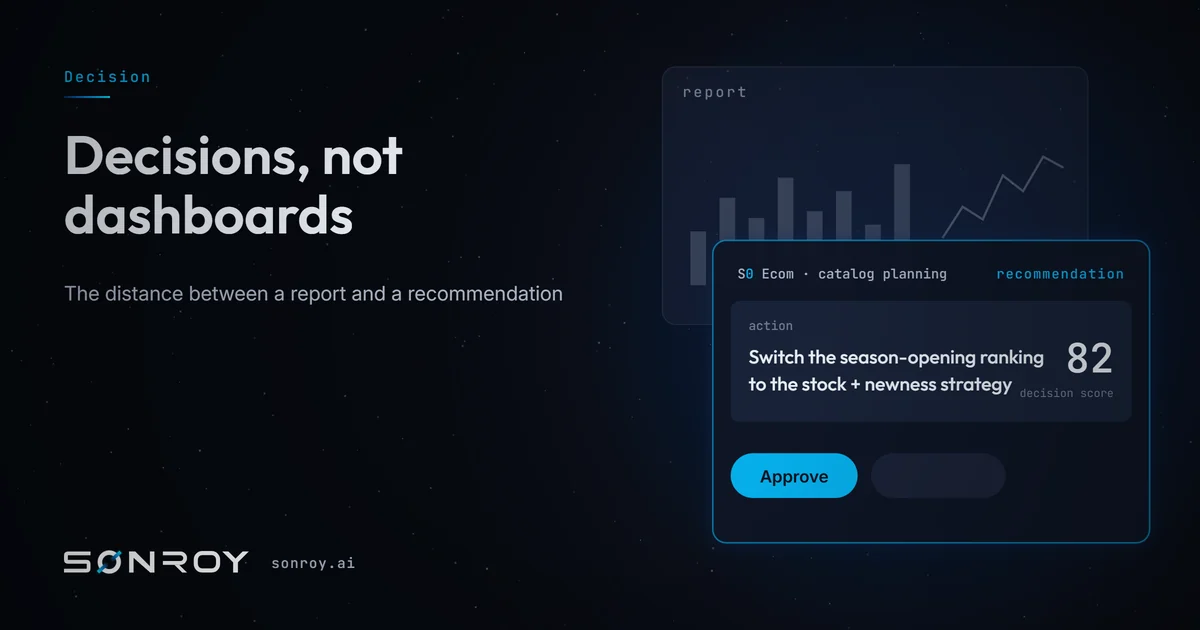
Decisions, not dashboards: the distance between a report and a recommendation
You do not measure the screen people look at; you measure the return of the decision they make. The difference between a report and a recommendation, what the approval triggers, and how it changes the management meeting.
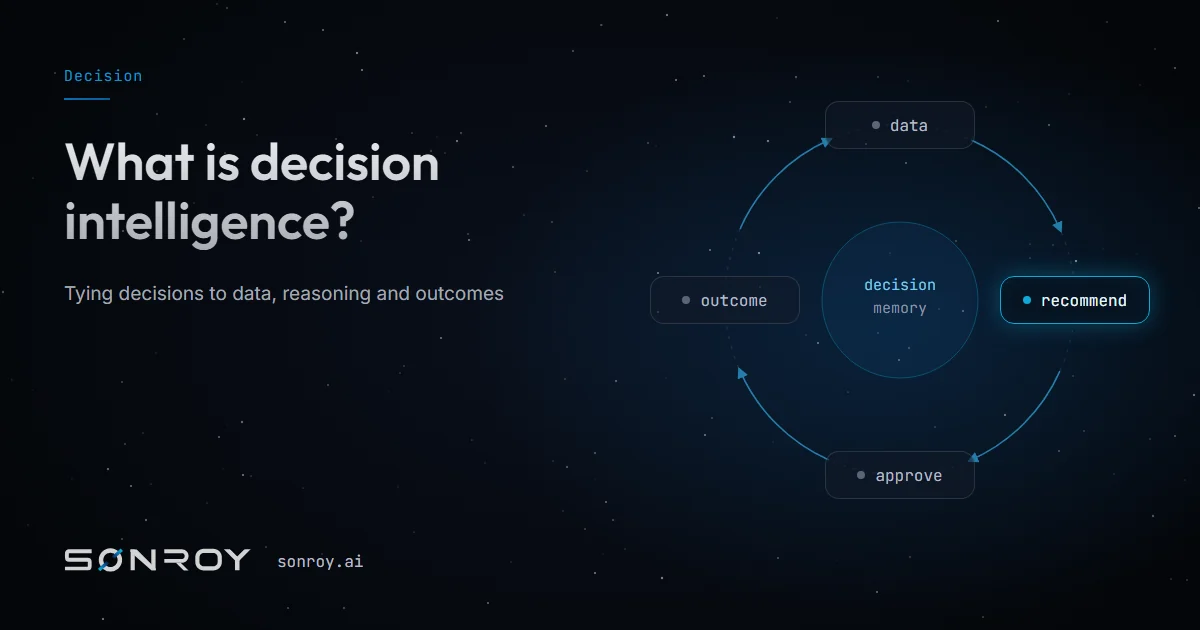
What is decision intelligence? A guide from data to decision
Decision intelligence is the discipline of engineering how decisions are made and learning from their outcomes. How it differs from BI, how it works in retail and where to start.