
End-of-season stock: markdown, transfer or hold?
There are four options for stock left at the end of a season: markdown, store-to-store transfer, a channel switch and holding. When each one is right and how the decision is made with data.
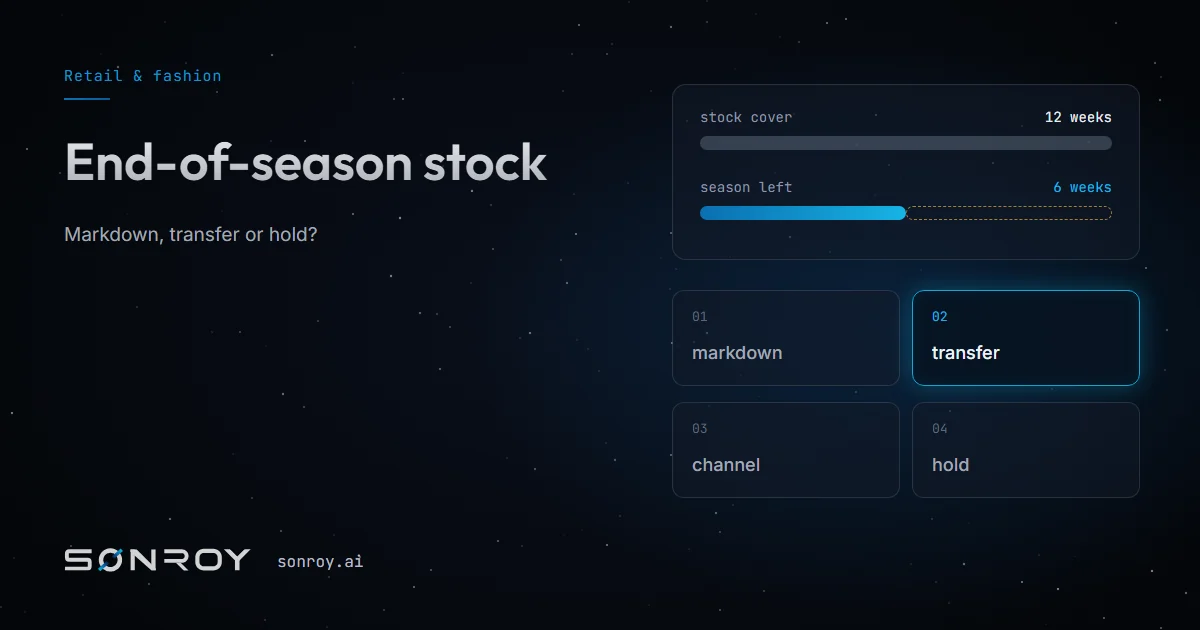
The end-of-season stock decision is choosing, for the product left over in the last weeks of a season, which option leaves the highest return: a markdown, a store-to-store transfer, a channel switch or holding the stock for next season. The decision repeats every season, and in most companies it is still made as a markdown list squeezed into the last two weeks.
Why does end-of-season stock build up?
From three sources. The first is forecast error: the order is placed at the start of the season, demand becomes clear during it. The second is broken size runs: a style's middle sizes sell out and the extremes remain; customers cannot find what they want, and the leftover stock sells harder because it is no longer a full run. The third is poor distribution: the product sells out in one store while it sits in another. Each has a different remedy, which is why a single markdown rate is not right for every product.
What options are there at the end of the season?
| Option | When it is right | Risk |
|---|---|---|
| Markdown | Demand exists but price is the barrier; little time left | Margin loss, training customers to wait for sales |
| Store-to-store transfer | The product sells out in one place and sits in another | Transfer cost; too late and it sells in neither |
| Channel switch | Stock stuck in stores could sell online or on a marketplace | One channel's price affecting the others |
| Hold | A seasonless basic that will sell at full price next season | Storage cost, the product going out of fashion |
When and how deep should you mark down?
An early, shallow markdown often leaves more margin than a late, deep one, because the product still sells in the weeks when there is demand. The decision has two inputs: stock cover (how many weeks the stock on hand lasts at today's rate of sale) and time left in the season. If cover is longer than the time left, the gap has to be split between markdown, transfer and holding. S0 Forecast's Stock Coverage module forecasts stock cover and the sell-out date; its Markdown Timing module forecasts the timing and depth of the markdown.
Example: a coat style
Say there are 1,200 units of a coat style six weeks before the season ends, selling 100 units a week (illustrative figures). Stock cover is twelve weeks; six weeks of season remain. At this rate 600 units sell and 600 remain. Instead of applying one markdown to all 600, you look at them separately: which sizes are broken runs, which stores sell fast, which colour was also left over last season. Broken runs are consolidated in one store, stock is transferred to the fast-selling stores, and the markdown is applied only to what remains, in stages.
Transfers and store-level decisions
The same product may be selling at a discount in one store while selling out at full price in another. That is why the end-of-season decision should be made at store level. S0 Store's Stock Allocation module recommends which product belongs in which store, its Store Markdown module recommends store-level price and markdown decisions, and ship-from-store, returns and transfers run through Omnichannel Fulfilment.
Which products should be held for next season?
Holding only makes sense for seasonless basics: a plain basic T-shirt, a basic pair of trousers. Holding a trend item just postpones selling it at an even deeper discount next season. The holding decision checks whether the product is in next season's collection plan.
End of season is next season's input
How much of each product group was left at season end, which sizes broke, how much each markdown sold: this is the most valuable data for next season. The outcome is written back to the forecast model, so the same mistake is not made twice. We cover the planning side in collection planning with data and the forecasting side in AI demand forecasting.
Where do you start?
At the end of this season, work out two numbers for every product group: stock cover and time left in the season. The groups whose cover is longer than the time left are where the decision has to be made. To see that list on your own stock and sales data, book a demo.
Short answers
When stock cover starts to exceed the time left in the season. That usually shows well before the last two weeks; an early, shallow markdown often leaves more margin than a late, deep one.
Stock on hand divided by the recent weekly rate of sale. The result shows how many weeks the stock lasts at today's pace.
Decide by looking at how that channel's price affects the main channels. If the main brand's price perception needs protecting, channel switches are kept limited and made product by product.
Summary
- End-of-season stock builds up from forecast error, broken size runs and poor distribution.
- There are four options: markdown, transfer, channel switch and hold.
- The decision compares stock cover with time left in the season, at store level.
- The season-end outcome is written back into next season's forecast and plan.
Related
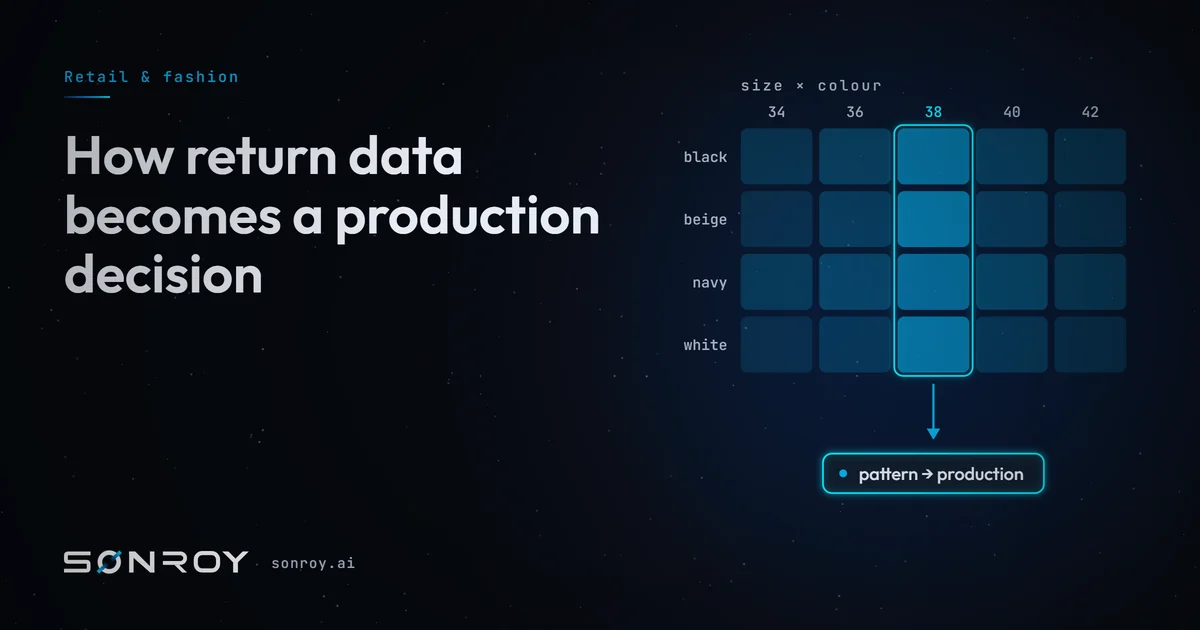
How return data becomes a production decision
The size × colour return matrix is not a report; it is a production instruction. The level at which returns should be read in fashion retail, three different causes, three different owners, and the path from that level to action.
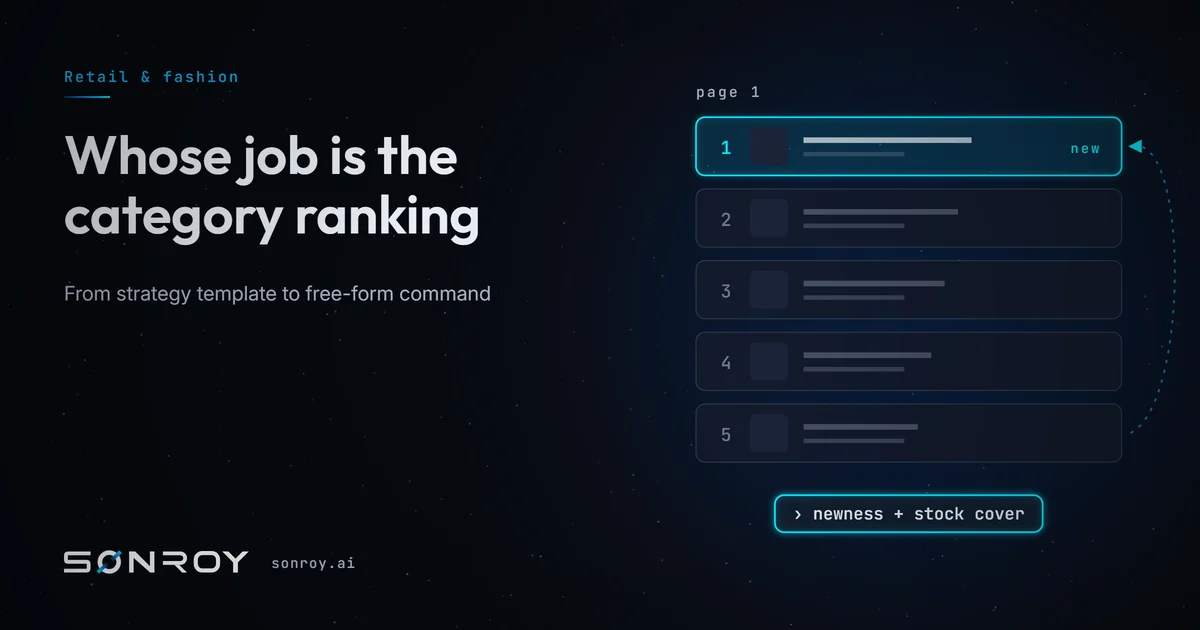
Whose job is the category ranking: from strategy template to free-form command
Deciding which product sits on the first page of an e-commerce category used to take a person days. How strategy templates and free-form commands reduced that work to one command, and where the category specialist's job moved.
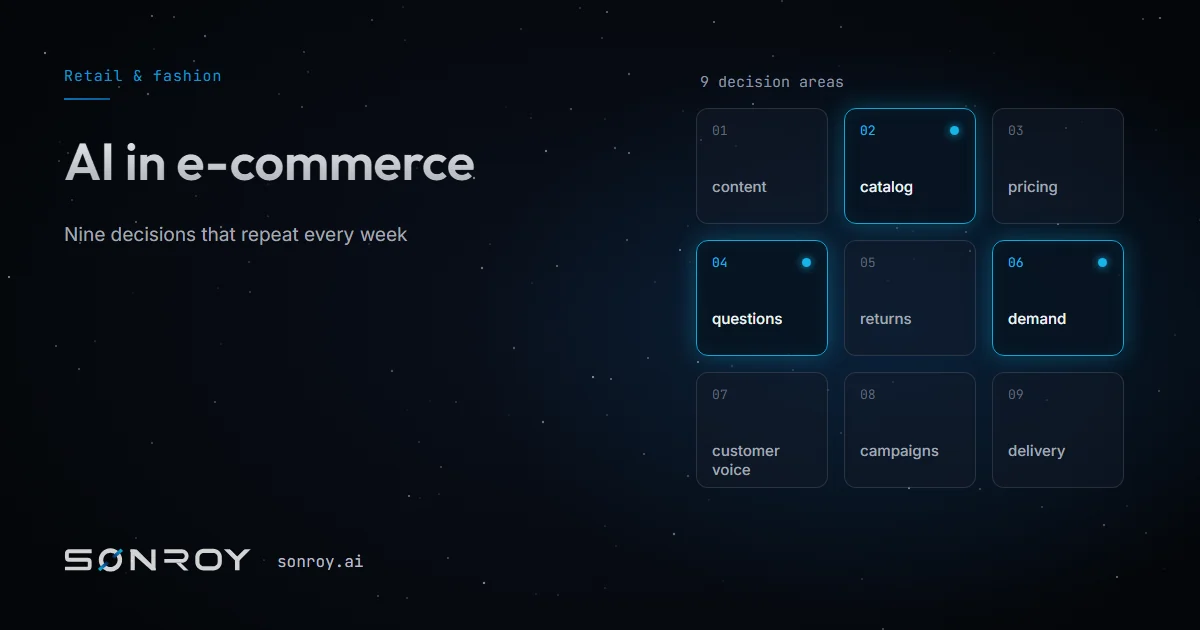
How to use AI in e-commerce: 9 decision areas
AI in e-commerce is not one tool but a set of decisions: product content, catalog ranking, competitor prices, customer questions, returns, demand and budget. What changes in each and where to start.